
Ch. 11 Fundamentals of the Nervous System and Nervous Tissue
Hoehn - Marieb Human Anatomy & Physiology, 12th edition
Hoehn, Haynes, Abbott12th EditionMarieb Human Anatomy & PhysiologyISBN: 9780138242732Not the one you use?Change textbook
Chapter 11, Problem 24

Explain both the anatomical and functional divisions of the nervous system. Include the subdivisions of each.

Verified step by step guidance
1
Start by defining the nervous system as a complex network responsible for coordinating body activities through electrical and chemical signals.
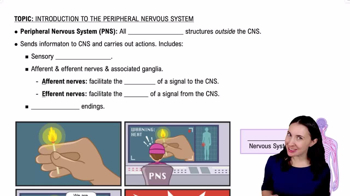
Explain the two main anatomical divisions: the Central Nervous System (CNS), which includes the brain and spinal cord, and the Peripheral Nervous System (PNS), which consists of all neural tissue outside the CNS.
Describe the functional divisions of the nervous system, which are based on the roles the nerves play: the Somatic Nervous System (SNS) that controls voluntary movements and sensory information, and the Autonomic Nervous System (ANS) that regulates involuntary functions.
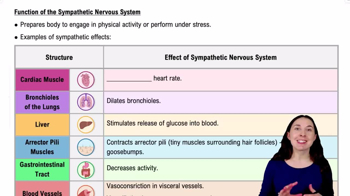
Break down the subdivisions of the PNS: the Somatic Nervous System (SNS) responsible for voluntary control of skeletal muscles, and the Autonomic Nervous System (ANS), which further divides into the Sympathetic division (prepares the body for 'fight or flight') and the Parasympathetic division (promotes 'rest and digest' activities).
Summarize by linking the anatomical and functional divisions, emphasizing how the CNS processes information and the PNS carries signals to and from the CNS, with the functional divisions specifying the type of control (voluntary or involuntary) exerted by the nervous system.

Verified video answer for a similar problem:

This video solution was recommended by our tutors as helpful for the problem above.
Video duration:
2m
Was this helpful?

Key Concepts

Here are the essential concepts you must grasp in order to answer the question correctly.

Anatomical Divisions of the Nervous System

The nervous system is anatomically divided into the central nervous system (CNS) and the peripheral nervous system (PNS). The CNS consists of the brain and spinal cord, serving as the main control center. The PNS includes all nerves outside the CNS, connecting it to limbs and organs.
Recommended video:
3:33
Peripheral Nervous System

Functional Divisions of the Nervous System

Functionally, the nervous system is divided into the somatic and autonomic nervous systems. The somatic system controls voluntary movements and sensory information, while the autonomic system regulates involuntary functions like heart rate and digestion.
Recommended video:
2:52
Function of the Sympathetic Nervous System

Subdivisions of the Functional Divisions

The autonomic nervous system further divides into the sympathetic and parasympathetic systems, which have opposing effects to maintain homeostasis. The somatic system includes sensory (afferent) and motor (efferent) pathways that transmit signals to and from the CNS.
Recommended video:
03:18
Importance of Cell Division
Related Practice
Textbook Question

Local anesthetics block voltage-gated Na⁺ channels. General anesthetics are thought to activate chemically gated Cl⁻ channels, thereby rendering the nervous system quiescent while surgery is performed. What specific process do anesthetics impair, and how does this interfere with nerve impulse transmission?

1167
views
Textbook Question

Rochelle developed multiple sclerosis when she was 27. After eight years she had lost a good portion of her ability to control her skeletal muscles. How did this happen?

1031
views
1
rank
Textbook Question

When admitted to the emergency room, Sean was holding his right hand, which had a deep puncture hole in its palm. He explained that he had fallen on a nail while exploring a barn. Sean was given an antitetanus shot to prevent neural complications. Tetanus bacteria fester in deep, dark wounds, but how do their toxins travel in neural tissue?

1073
views
1
rank
Textbook Question

The effects of neurotransmitter binding are very brief. Explain.

92
views
Textbook Question

Describe the events that must occur to generate an AP. Relate the sequence of changes in permeability to changes in the ion channels, and explain why the AP is an all-or-none phenomenon.

1251
views
1
rank
Textbook Question

In the Netherlands a young man named Jan was admitted to the emergency room. He and his friends had been to a rave. His friends say he started twitching and having muscle spasms which progressed until he was 'stiff as a board.' On examination, staff found a marked increase in muscle tone and hyperreflexia involving facial and limb muscles. In his pocket, he had unmarked dark yellow tablets with dark flecks. Analysis of the tablets showed them to contain a mixture of ecstasy and strychnine. Ecstasy would not cause this clinical picture, but strychnine, which blocks glycine receptors, could. Explain how.

851
views