Ch. 13 The Peripheral Nervous System and Reflex Activity
Hoehn - Marieb Human Anatomy & Physiology, 12th edition
Hoehn, Haynes, Abbott12th EditionMarieb Human Anatomy & PhysiologyISBN: 9780138242732Not the one you use?Change textbook
Chapter 13, Problem 20

(a) Describe the formation and composition of a spinal nerve.
(b) Name the branches of a spinal nerve (other than the rami communicantes), and indicate their distribution.

Verified step by step guidance
1
(a) Begin by explaining that a spinal nerve is formed by the union of two roots: the dorsal (posterior) root and the ventral (anterior) root. The dorsal root contains sensory (afferent) fibers, while the ventral root contains motor (efferent) fibers. These roots merge to form a mixed spinal nerve that carries both sensory and motor information.
Next, describe the composition of the spinal nerve, emphasizing that it contains both sensory and motor neurons, as well as autonomic fibers. The nerve is surrounded by connective tissue layers: the endoneurium around individual axons, the perineurium around fascicles (bundles of axons), and the epineurium surrounding the entire nerve.
(b) Identify the main branches of a spinal nerve after it forms, excluding the rami communicantes. These branches include the dorsal (posterior) ramus and the ventral (anterior) ramus.
Explain the distribution of the dorsal ramus, which innervates the muscles and skin of the back (the deep muscles of the back and the overlying skin).
Then, describe the ventral ramus, which is larger and innervates the anterior and lateral parts of the trunk and the limbs. It also contributes to the formation of nerve plexuses such as the cervical, brachial, lumbar, and sacral plexuses.

Key Concepts

Here are the essential concepts you must grasp in order to answer the question correctly.

Formation of a Spinal Nerve

A spinal nerve is formed by the union of two roots: the dorsal (posterior) root, which carries sensory fibers, and the ventral (anterior) root, which carries motor fibers. These roots emerge from the spinal cord and combine to form a mixed nerve that transmits both sensory and motor signals.
Recommended video:
4:04
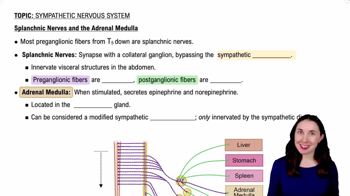
Splanchnic Nerves and the Adrenal Medulla

Composition of a Spinal Nerve

Spinal nerves are mixed nerves containing both afferent (sensory) and efferent (motor) fibers. They include somatic and autonomic fibers, allowing communication between the central nervous system and the body’s muscles, skin, and organs.
Recommended video:
7:49
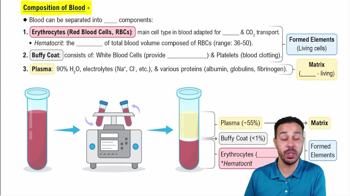
Composition of Blood

Branches of a Spinal Nerve and Their Distribution

After formation, a spinal nerve divides into several branches: the dorsal ramus (innervates muscles and skin of the back), the ventral ramus (innervates limbs and anterior body wall), and meningeal branches (supply spinal cord coverings). Rami communicantes connect to the sympathetic trunk but are excluded here.
Recommended video:
4:04
Splanchnic Nerves and the Adrenal Medulla