Besides the ability to move by amoeboid motion, what other physiological attributes contribute to the function of white blood cells in the body?
Ch. 17 Blood
Hoehn, Haynes, Abbott12th EditionMarieb Human Anatomy & PhysiologyISBN: 9780138242732Not the one you use?Change textbook
Chapter 17, Problem 13
If you had a high hematocrit, would you expect your hemoglobin determination to be low or high? Why?
Verified step by step guidance1
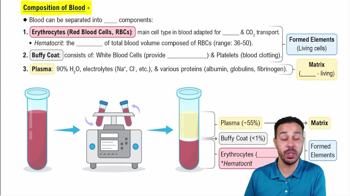
Step 1: Understand what hematocrit and hemoglobin represent. Hematocrit is the percentage of red blood cells (RBCs) in the total blood volume, while hemoglobin is the oxygen-carrying protein inside those RBCs.
Step 2: Recognize that a high hematocrit means there is a higher proportion of red blood cells in the blood compared to plasma.
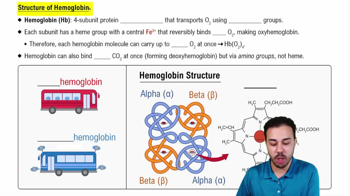
Step 3: Since hemoglobin is contained within red blood cells, an increase in the number of RBCs generally means there will be more hemoglobin present in the blood.
Step 4: Therefore, if hematocrit is high, you would expect the hemoglobin concentration to be high as well, because more RBCs usually mean more hemoglobin molecules available to carry oxygen.
Step 5: Summarize that the relationship between hematocrit and hemoglobin is directly proportional under normal physiological conditions, so a high hematocrit typically corresponds to a high hemoglobin determination.

Verified video answer for a similar problem:
This video solution was recommended by our tutors as helpful for the problem above.
Video duration:
1mWas this helpful?
Key Concepts
Here are the essential concepts you must grasp in order to answer the question correctly.
Hematocrit
Hematocrit is the percentage of red blood cells (RBCs) in the total blood volume. A high hematocrit means there is a greater proportion of RBCs, which typically indicates thicker blood or increased oxygen-carrying capacity.
Recommended video:
Composition of Blood
Hemoglobin
Hemoglobin is the protein in red blood cells responsible for carrying oxygen. Its concentration in blood is usually proportional to the number of RBCs, so higher RBC counts generally lead to higher hemoglobin levels.
Recommended video:
Structure of Hemoglobin
Relationship Between Hematocrit and Hemoglobin
Since hematocrit measures the volume of RBCs and hemoglobin measures the oxygen-carrying protein within those cells, a high hematocrit usually correlates with a high hemoglobin concentration. Therefore, if hematocrit is high, hemoglobin is expected to be high as well.
Recommended video:
Structure of Hemoglobin
Related Practice
Textbook Question
1019
views
Textbook Question
Suppose your blood is AB positive. This means that:
a. Agglutinogens A and B are present on your red blood cells
b. There are no anti-A or anti-B antibodies in your plasma
c. Your blood is Rh⁺
d. All of the above
1022
views
Textbook Question
List the three major categories of formed elements
Which is least numerous?
Which comprise(s) the buffy coat in a hematocrit tube?
1472
views
Textbook Question
If you had a severe infection, would you expect your WBC count to be closest to 5000, 10,000, or 15,000/μl?
What is this condition called?
980
views
Textbook Question
What is a transfusion reaction, and why does it happen?
What are its possible consequences?
716
views
Textbook Question
Describe the process of erythropoiesis
What name is given to the immature cell type released to the circulation?
How does it differ from a mature erythrocyte?
1597
views