
Textbook Question
Which of the following covalently bonded molecules are polar?
(a)
(b)
(c)
(d)
59
views

 Verified step by step guidance
 06:50
06:50
 07:59
07:59 02:52
02:52Which of the following covalently bonded molecules are polar?
(a)
(b)
(c)
(d)
Identify each reaction as one of the following:
a. A synthesis reaction
b. A decomposition reaction
c. An exchange reaction
(1) 2Hg + O₂ → 2HgO
(2) HCl + NaOH → NaCl + H₂O
A chemist, during the course of an analysis, runs across a chemical composed of carbon, hydrogen, and oxygen in the proportion 1:2:1 and having a six-sided molecular shape. It is probably:
a. A pentose
b. An amino acid
c. A fatty acid
d. A monosaccharide
e. A nucleic acid
What are hydrogen bonds and how are they important in the body?
Differentiate clearly between primary, secondary, and tertiary protein structure.
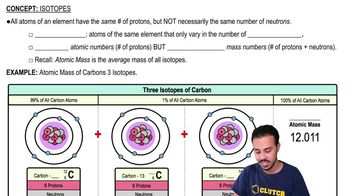
Consider the following information about three atoms: 12/6 C 13/6 C 14/6 C
a. How are they similar to one another?
b. How do they differ from one another?
c. What are the members of such a group of atoms called?
d. Using the planetary model, draw the atomic configuration of 12/6 C, showing the relative position and numbers of its subatomic particles