
Ch. 20 The Lymphatic System and Lymphoid Organs and Tissues
Hoehn - Marieb Human Anatomy & Physiology, 12th edition
Hoehn, Haynes, Abbott12th EditionMarieb Human Anatomy & PhysiologyISBN: 9780138242732Not the one you use?Change textbook
Chapter 20, Problem 13

Which anatomical characteristic ensures that the flow of lymph through a lymph node is slow?
Why is this desirable?

Verified step by step guidance
1
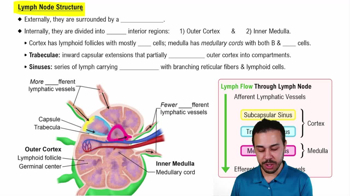
Understand the structure of a lymph node, focusing on the pathways lymph takes as it enters and exits the node. Lymph enters through multiple afferent lymphatic vessels and exits through fewer efferent lymphatic vessels.
Recognize that the anatomical characteristic responsible for slowing lymph flow is the presence of fewer efferent lymphatic vessels compared to afferent vessels, creating a bottleneck effect.
Explain that this bottleneck causes lymph to move more slowly through the lymph node, allowing more time for immune cells within the node to interact with and filter the lymph.
Discuss why slow lymph flow is desirable: it enhances the immune surveillance process by giving lymphocytes and macrophages sufficient time to detect and respond to pathogens, debris, or abnormal cells present in the lymph.
Summarize that the combination of multiple afferent vessels and a single or fewer efferent vessels ensures a controlled, slow flow of lymph, optimizing the lymph node's role in immune defense.

Verified video answer for a similar problem:

This video solution was recommended by our tutors as helpful for the problem above.
Video duration:
1m
Was this helpful?

Key Concepts

Here are the essential concepts you must grasp in order to answer the question correctly.

Structure of Afferent and Efferent Lymphatic Vessels

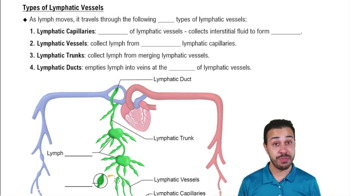
Lymph nodes have multiple afferent lymphatic vessels bringing lymph in, but only one or few efferent vessels for lymph to exit. This anatomical arrangement creates a bottleneck effect, slowing lymph flow through the node to allow adequate filtration.
Recommended video:
7:02
Types of Lymphatic Vessels

Lymph Node Sinuses and Their Role in Flow Regulation

Within the lymph node, lymph passes through a network of sinuses lined with macrophages and reticular fibers. These sinuses create resistance and slow the lymph flow, facilitating the trapping of pathogens and debris for immune surveillance.
Recommended video:
10:32
Lymph Node Structure

Importance of Slow Lymph Flow for Immune Function

Slowing lymph flow allows immune cells in the lymph node sufficient time to detect and respond to foreign antigens. This enhances the efficiency of immune activation and the removal of harmful substances before lymph returns to circulation.
Recommended video:
10:32
Lymph Node Structure