
Ch. 23 The Digestive System
Hoehn - Marieb Human Anatomy & Physiology, 12th edition
Hoehn, Haynes, Abbott12th EditionMarieb Human Anatomy & PhysiologyISBN: 9780138242732Not the one you use?Change textbook
Chapter 23, Problem 29

A baby is admitted to the hospital with a history of diarrhea and watery feces occurring over the last three days. The baby has sunken fontanelles (the not yet ossified spaces between skull bones in infants), indicating extreme dehydration. Tests indicate that the baby has a bacterium-induced colitis, and antibiotics are prescribed. Because of the baby's loss of intestinal juices, do you think that his blood pH would indicate acidosis or alkalosis? Explain your reasoning.

Verified step by step guidance
1
Step 1: Understand the physiological impact of diarrhea and watery feces. Diarrhea leads to the loss of intestinal fluids, which are rich in bicarbonate ions (HCO₃⁻). Bicarbonate ions play a crucial role in maintaining blood pH by buffering excess hydrogen ions (H⁺). Loss of these ions can disrupt the acid-base balance in the body.
Step 2: Recall the relationship between bicarbonate loss and blood pH. When bicarbonate ions are lost, the buffering capacity of the blood decreases, leading to an accumulation of hydrogen ions (H⁺). This results in a decrease in blood pH, a condition known as acidosis.
Step 3: Consider the symptoms of dehydration and colitis. The baby's sunken fontanelles indicate severe dehydration, which can exacerbate the loss of bicarbonate through diarrhea. Additionally, bacterium-induced colitis may further impair the intestinal lining, increasing fluid and bicarbonate loss.
Step 4: Relate the physiological changes to the blood pH. The loss of bicarbonate ions due to diarrhea and colitis directly contributes to metabolic acidosis, as the body cannot adequately buffer the excess hydrogen ions.
Step 5: Conclude that the baby's blood pH would likely indicate acidosis. This conclusion is based on the loss of bicarbonate ions from intestinal juices, the symptoms of dehydration, and the underlying bacterial infection causing colitis.

Verified video answer for a similar problem:

This video solution was recommended by our tutors as helpful for the problem above.
Video duration:
2m
Was this helpful?

Key Concepts

Here are the essential concepts you must grasp in order to answer the question correctly.

Acidosis and Alkalosis

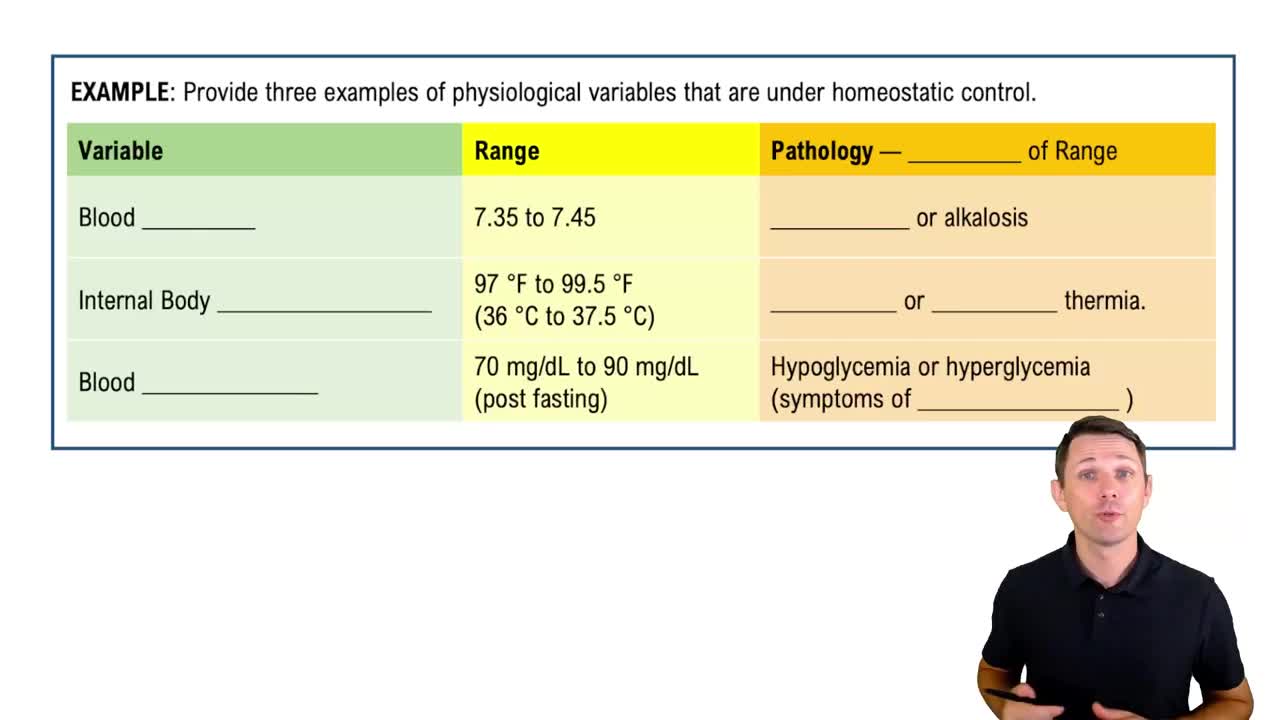
Acidosis and alkalosis refer to the conditions of the body's pH balance. Acidosis occurs when the blood pH falls below 7.35, indicating an excess of hydrogen ions, while alkalosis occurs when the pH rises above 7.45, indicating a deficiency of hydrogen ions. Understanding these conditions is crucial for assessing the impact of dehydration and electrolyte imbalances on the body's acid-base status.
Recommended video:
Guided course
03:46
Homeostasis Example 1

Dehydration and Electrolyte Loss

Dehydration results from excessive loss of fluids, which can lead to a significant decrease in electrolytes such as sodium and potassium. In infants, dehydration can be particularly severe due to their smaller body size and higher fluid turnover. This loss can disrupt normal physiological functions, including acid-base balance, potentially leading to acidosis.
Recommended video:
07:59
Osmosis and Osmolarity

Bacterium-Induced Colitis

Bacterium-induced colitis is an inflammation of the colon caused by bacterial infection, often leading to diarrhea and fluid loss. This condition can exacerbate dehydration and contribute to metabolic disturbances, including changes in blood pH. Understanding the implications of colitis is essential for predicting the potential for acidosis in the context of fluid and electrolyte loss.
Recommended video:
4:02
Retinoic Acid Inducible Gene (RIG)-Like Receptors
Related Practice
Textbook Question

Troy Francis, a middle-aged salesman, complains of a burning pain in the 'pit of his stomach,' usually beginning about two hours after eating and abating after drinking a glass of milk. When asked to indicate the site, he points to his epigastric region. The GI tract is examined by X-ray fluoroscopy. A gastric ulcer is visualized, and drug therapy using a proton pump inhibitor and antibiotics is recommended.

a. Why is this treatment suggested?

b. What are the possible consequences of nontreatment?

774
views
Textbook Question

After a heavy meal rich with fried foods, Debby Collins, an overweight 45-year-old woman, was rushed to the emergency room with severe spasmodic pains in her epigastric region that radiated to the right side of her rib cage. She indicated that the attack came on suddenly, and her abdomen was found to be tender to the touch and somewhat rigid. What do you think is this patient's problem and why is her pain discontinuous (colicky)? What are the treatment options and what might happen if the problem is not resolved?

844
views
Textbook Question

Dr. Dolan used an endoscope to view Mr. Habib’s colon. He noted the presence of several polyps and removed them during the same procedure. What is an endoscope? Why did Dr. Dolan opt to remove the polyps immediately?

1
views
Textbook Question

Mr. Holden has had severe diarrhea all day and is severely weakened. Explain why his nurse is concerned about his present condition.

97
views
Textbook Question

Explain why activation of pancreatic enzymes is delayed until they reach the small intestine.

1276
views
Textbook Question

Indicate the function of the stellate macrophages and the hepatocytes of the liver.

1098
views