Ch. 28 Pregnancy and Human Development

Hoehn, Haynes, Abbott12th EditionMarieb Human Anatomy & PhysiologyISBN: 9780138242732
Not the one you use?Change textbookSelect a different textbook
Table of contents
- Ch. 1 The Human Body: An Orientation25
- Ch. 2 Chemistry Comes Alive24
- Ch. 3 Cells: The Living Units24
- Ch. 4 Tissue: The Living Fabric19
- Ch. 5 The Integumentary System12
- Ch. 6 Bones and Skeletal Tissues19
- Ch. 7 The Skeleton14
- Ch. 8 Joints7
- Ch. 9 Muscles and Muscle Tissue26
- Ch. 10 The Muscular System25
- Ch. 11 Fundamentals of the Nervous System and Nervous Tissue23
- Ch. 12 The Central Nervous System25
- Ch. 13 The Peripheral Nervous System and Reflex Activity30
- Ch. 14 The Autonomic Nervous System16
- Ch. 15 The Special Senses26
- Ch. 16 The Endocrine System26
- Ch. 17 Blood27
- Ch. 18 The Cardiovascular System: The Heart25
- Ch. 19 The Cardiovascular System: Blood Vessels27
- Ch. 20 The Lymphatic System and Lymphoid Organs and Tissues16
- Ch. 21 The Immune System: Innate and Adaptive Body Defenses27
- Ch. 22 The Respiratory System21
- Ch. 23 The Digestive System31
- Ch. 24 Nutrition, Metabolism, and Energy Balance26
- Ch. 25 The Urinary System26
- Ch. 26 Fluid, Electrolyte, and Acid-Base Balance24
- Ch. 27 The Reproductive System24
- Ch. 28 Pregnancy and Human Development25
- Ch. 29 Heredity11
Hoehn, Haynes, Abbott12th EditionMarieb Human Anatomy & PhysiologyISBN: 9780138242732Not the one you use?Change textbook

Chapter 28, Problem 1
Indicate whether each of the following statements is describing (a) cleavage or (b) gastrulation.
_______ (1) period during which a morula forms
_______ (2) period when vast amounts of cell migration occur
_______ (3) period when the three embryonic germ layers appear
_______ (4) period during which the blastocyst is formed
 Verified step by step guidance
1
Step 1: Understand the definitions of the two processes: Cleavage is the early embryonic stage characterized by rapid cell division without growth, leading to the formation of a morula and then a blastocyst. Gastrulation is a later stage involving extensive cell migration and the formation of the three primary germ layers (ectoderm, mesoderm, and endoderm).
Step 2: Identify which process corresponds to the formation of a morula. Since the morula is a solid ball of cells formed by cleavage divisions, this period is part of cleavage.
Step 3: Determine which process involves vast amounts of cell migration. Gastrulation is known for significant cell movements as cells migrate to form distinct layers, so this period corresponds to gastrulation.
Step 4: Recognize when the three embryonic germ layers appear. The formation of these layers is the hallmark of gastrulation, so this period is gastrulation.
Step 5: Identify the period during which the blastocyst is formed. The blastocyst forms after the morula during cleavage, so this period is part of cleavage.
Key Concepts
Here are the essential concepts you must grasp in order to answer the question correctly.
Cleavage
Cleavage is the early embryonic stage characterized by rapid mitotic cell divisions without growth, transforming the zygote into a multicellular structure called the morula. This process increases cell number while maintaining the original embryo size, setting the stage for later development.
Recommended video:

 3:03
3:03
Cleavage: Days 2-3
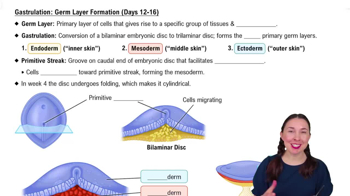
Gastrulation
Gastrulation is a critical phase in embryonic development involving extensive cell migration and reorganization, leading to the formation of the three primary germ layers: ectoderm, mesoderm, and endoderm. These layers give rise to all tissues and organs in the organism.
Recommended video:
 3:54
3:54Gastrulation: Germ Layer Formation (Days 12-16)
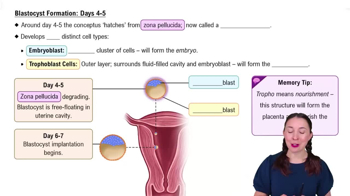
Blastocyst Formation
Blastocyst formation occurs after cleavage, when the embryo develops a fluid-filled cavity called the blastocoel, differentiating into an outer trophoblast and an inner cell mass. This structure is essential for implantation and subsequent embryonic development.
Recommended video:
 2:18
2:18Blastocyst Formation: Days 4-5
Related Practice