Ch. 28 Pregnancy and Human Development
Hoehn, Haynes, Abbott12th EditionMarieb Human Anatomy & PhysiologyISBN: 9780138242732
Not the one you use?Change textbookSelect a different textbook
Table of contents
- Ch. 1 The Human Body: An Orientation25
- Ch. 2 Chemistry Comes Alive24
- Ch. 3 Cells: The Living Units24
- Ch. 4 Tissue: The Living Fabric19
- Ch. 5 The Integumentary System12
- Ch. 6 Bones and Skeletal Tissues19
- Ch. 7 The Skeleton14
- Ch. 8 Joints7
- Ch. 9 Muscles and Muscle Tissue26
- Ch. 10 The Muscular System25
- Ch. 11 Fundamentals of the Nervous System and Nervous Tissue23
- Ch. 12 The Central Nervous System25
- Ch. 13 The Peripheral Nervous System and Reflex Activity30
- Ch. 14 The Autonomic Nervous System16
- Ch. 15 The Special Senses26
- Ch. 16 The Endocrine System26
- Ch. 17 Blood27
- Ch. 18 The Cardiovascular System: The Heart25
- Ch. 19 The Cardiovascular System: Blood Vessels27
- Ch. 20 The Lymphatic System and Lymphoid Organs and Tissues16
- Ch. 21 The Immune System: Innate and Adaptive Body Defenses27
- Ch. 22 The Respiratory System21
- Ch. 23 The Digestive System31
- Ch. 24 Nutrition, Metabolism, and Energy Balance26
- Ch. 25 The Urinary System26
- Ch. 26 Fluid, Electrolyte, and Acid-Base Balance24
- Ch. 27 The Reproductive System24
- Ch. 28 Pregnancy and Human Development25
- Ch. 29 Heredity11
Hoehn, Haynes, Abbott12th EditionMarieb Human Anatomy & PhysiologyISBN: 9780138242732Not the one you use?Change textbook

Chapter 28, Problem 4
Match each adult structure in column B with the embryonic structure it derives from in column A.
Column A
_______ (1) notochord
_______ (2) ectoderm (not neural tube)
_______ (3) intermediate mesoderm
_______ (4) lateral plate mesoderm
_______ (5) sclerotome
_______ (6) coelom
_______ (7) neural tube
_______ (8) endoderm
Column B
(a) kidney
(b) peritoneal cavity
(c) pancreas, liver
(d) parietal serosa, most tissues of limbs
(e) nucleus pulposus
(f) hair and epidermis
(g) brain
(h) ribs and vertebrae
 Verified step by step guidance
1
Step 1: Understand the embryonic structures and their general derivatives. For example, the notochord is a midline structure important in development, ectoderm forms the outer layer of the embryo, intermediate mesoderm contributes to urogenital structures, lateral plate mesoderm forms body cavities and limb tissues, sclerotome is part of the somite that forms vertebrae and ribs, coelom is the embryonic body cavity, neural tube develops into the central nervous system, and endoderm forms internal linings and organs like the liver and pancreas.
Step 2: Match the notochord (1) with its adult derivative. The notochord primarily forms the nucleus pulposus of intervertebral discs, so it corresponds to (e) nucleus pulposus.
Step 3: Match the ectoderm (not neural tube) (2) with its adult derivatives. The ectoderm forms the epidermis and hair, so it corresponds to (f) hair and epidermis.
Step 4: Match the intermediate mesoderm (3) with its adult derivatives. The intermediate mesoderm gives rise to the urogenital system, including the kidneys, so it corresponds to (a) kidney.
Step 5: Continue matching the remaining embryonic structures to their adult derivatives by recalling their developmental roles: lateral plate mesoderm (4) forms the parietal serosa and limb tissues (d), sclerotome (5) forms ribs and vertebrae (h), coelom (6) becomes the peritoneal cavity (b), neural tube (7) develops into the brain (g), and endoderm (8) forms internal organs like the pancreas and liver (c).
Key Concepts
Here are the essential concepts you must grasp in order to answer the question correctly.
Germ Layers and Their Derivatives
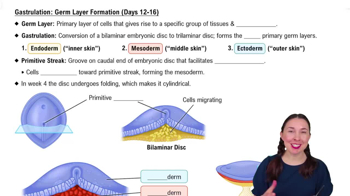
The three primary germ layers—ectoderm, mesoderm, and endoderm—form during embryogenesis and give rise to all tissues and organs. Understanding which adult structures originate from each layer is essential for matching embryonic structures to their adult derivatives.
Recommended video:
 3:54
3:54
Gastrulation: Germ Layer Formation (Days 12-16)
Mesoderm Subdivisions and Their Roles
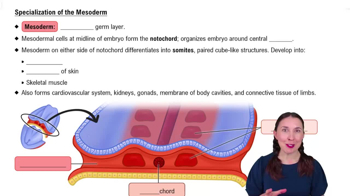
The mesoderm splits into paraxial, intermediate, and lateral plate mesoderm, each contributing to specific tissues. For example, the sclerotome (from paraxial mesoderm) forms vertebrae and ribs, while the intermediate mesoderm forms kidneys, and the lateral plate mesoderm forms limb tissues and serous membranes.
Recommended video:
 2:45
2:45Specialization of the Mesoderm
Neural Tube and Notochord Functions
The notochord is a rod-like structure that induces neural tube formation and later becomes the nucleus pulposus of intervertebral discs. The neural tube develops into the central nervous system, including the brain and spinal cord, while ectoderm outside the neural tube forms skin and hair.
Recommended video:
 3:58
3:58The Uterine Tubes
Related Practice