Ch. 28 Pregnancy and Human Development

Hoehn, Haynes, Abbott12th EditionMarieb Human Anatomy & PhysiologyISBN: 9780138242732
Not the one you use?Change textbookSelect a different textbook
Table of contents
- Ch. 1 The Human Body: An Orientation25
- Ch. 2 Chemistry Comes Alive24
- Ch. 3 Cells: The Living Units24
- Ch. 4 Tissue: The Living Fabric19
- Ch. 5 The Integumentary System12
- Ch. 6 Bones and Skeletal Tissues19
- Ch. 7 The Skeleton14
- Ch. 8 Joints7
- Ch. 9 Muscles and Muscle Tissue26
- Ch. 10 The Muscular System25
- Ch. 11 Fundamentals of the Nervous System and Nervous Tissue23
- Ch. 12 The Central Nervous System25
- Ch. 13 The Peripheral Nervous System and Reflex Activity30
- Ch. 14 The Autonomic Nervous System16
- Ch. 15 The Special Senses26
- Ch. 16 The Endocrine System26
- Ch. 17 Blood27
- Ch. 18 The Cardiovascular System: The Heart25
- Ch. 19 The Cardiovascular System: Blood Vessels27
- Ch. 20 The Lymphatic System and Lymphoid Organs and Tissues16
- Ch. 21 The Immune System: Innate and Adaptive Body Defenses27
- Ch. 22 The Respiratory System21
- Ch. 23 The Digestive System31
- Ch. 24 Nutrition, Metabolism, and Energy Balance26
- Ch. 25 The Urinary System26
- Ch. 26 Fluid, Electrolyte, and Acid-Base Balance24
- Ch. 27 The Reproductive System24
- Ch. 28 Pregnancy and Human Development25
- Ch. 29 Heredity11
Hoehn, Haynes, Abbott12th EditionMarieb Human Anatomy & PhysiologyISBN: 9780138242732Not the one you use?Change textbook

Chapter 28, Problem 23
The placenta is a marvelous, but temporary, organ. Starting with a description of its formation, show how it is an intimate part of both fetal and maternal anatomy and physiology during the gestation period.
 Verified step by step guidance
1
Begin by describing the formation of the placenta, which starts with the blastocyst embedding into the uterine wall. Explain how the trophoblast layer of the blastocyst differentiates into two layers: the cytotrophoblast and syncytiotrophoblast, which invade the maternal endometrium to establish the placenta.
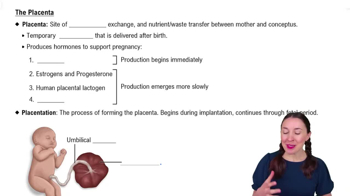
Explain how the placenta forms a physical and functional interface between the maternal and fetal circulations. Highlight that fetal blood vessels develop within the chorionic villi, which are surrounded by maternal blood in the intervillous spaces, allowing exchange without direct blood mixing.
Describe the dual role of the placenta in fetal and maternal physiology: for the fetus, it provides oxygen and nutrients, removes waste products, and produces hormones essential for development; for the mother, it modifies the uterine lining and regulates immune tolerance to prevent rejection of the fetus.
Discuss the hormonal functions of the placenta, including the secretion of human chorionic gonadotropin (hCG), progesterone, and estrogen, which maintain pregnancy and prepare maternal tissues for childbirth and lactation.
Conclude by emphasizing the placenta's temporary yet vital role as a bridge between mother and fetus, integrating their anatomies and physiologies to support fetal growth and maternal adaptation throughout gestation.
Key Concepts
Here are the essential concepts you must grasp in order to answer the question correctly.
Formation of the Placenta
The placenta forms early in pregnancy from the trophoblast cells of the blastocyst, which invade the maternal endometrium. This process establishes the maternal-fetal interface, enabling nutrient and gas exchange. Understanding its development highlights how fetal and maternal tissues integrate structurally.
Recommended video:
 2:19
2:19
The Placenta
Maternal-Fetal Interface and Anatomy
The placenta connects fetal chorionic villi with the maternal uterine lining, creating a close but separate interface. This anatomical arrangement allows selective exchange of oxygen, nutrients, and waste without direct blood mixing, emphasizing its role as a shared organ between mother and fetus.
Recommended video:
 4:14
4:14Clitoral Anatomy
Physiological Functions of the Placenta
Beyond nutrient and gas exchange, the placenta produces hormones like hCG and progesterone to maintain pregnancy and modulates immune tolerance to protect the fetus. These physiological roles demonstrate its critical function in supporting fetal development and adapting maternal systems.
Recommended video:
2:19The Placenta
Related Practice