Ch. 29 Heredity
Hoehn, Haynes, Abbott12th EditionMarieb Human Anatomy & PhysiologyISBN: 9780138242732
Not the one you use?Change textbookSelect a different textbook
Table of contents
- Ch. 1 The Human Body: An Orientation25
- Ch. 2 Chemistry Comes Alive24
- Ch. 3 Cells: The Living Units24
- Ch. 4 Tissue: The Living Fabric19
- Ch. 5 The Integumentary System12
- Ch. 6 Bones and Skeletal Tissues19
- Ch. 7 The Skeleton14
- Ch. 8 Joints7
- Ch. 9 Muscles and Muscle Tissue26
- Ch. 10 The Muscular System25
- Ch. 11 Fundamentals of the Nervous System and Nervous Tissue23
- Ch. 12 The Central Nervous System25
- Ch. 13 The Peripheral Nervous System and Reflex Activity30
- Ch. 14 The Autonomic Nervous System16
- Ch. 15 The Special Senses26
- Ch. 16 The Endocrine System26
- Ch. 17 Blood27
- Ch. 18 The Cardiovascular System: The Heart25
- Ch. 19 The Cardiovascular System: Blood Vessels27
- Ch. 20 The Lymphatic System and Lymphoid Organs and Tissues16
- Ch. 21 The Immune System: Innate and Adaptive Body Defenses27
- Ch. 22 The Respiratory System21
- Ch. 23 The Digestive System31
- Ch. 24 Nutrition, Metabolism, and Energy Balance26
- Ch. 25 The Urinary System26
- Ch. 26 Fluid, Electrolyte, and Acid-Base Balance24
- Ch. 27 The Reproductive System24
- Ch. 28 Pregnancy and Human Development25
- Ch. 29 Heredity11
Hoehn, Haynes, Abbott12th EditionMarieb Human Anatomy & PhysiologyISBN: 9780138242732Not the one you use?Change textbook

Chapter 29, Problem 10
A color-blind man marries a woman with normal vision. The woman’s father was also color-blind.
(a) What is the chance that their first child will be a color-blind son? A color-blind daughter?
(b) If they have four children, what is the chance that two will be color-blind sons? (Be careful on this one.)
 Verified step by step guidance
1
Step 1: Identify the inheritance pattern of color blindness. Color blindness is typically an X-linked recessive trait. This means the gene causing color blindness is located on the X chromosome, and males (XY) are more likely to express the trait because they have only one X chromosome, while females (XX) need two copies of the defective gene to be color-blind.
Step 2: Determine the genotypes of the parents. The man is color-blind, so his genotype is X\^cY (where X\^c represents the X chromosome carrying the color-blind allele). The woman has normal vision but her father was color-blind, so she must be a carrier with genotype X\^CX\^c (X\^C is the normal allele, X\^c is the color-blind allele).
Step 3: Set up a Punnett square to find the possible genotypes of their children. The mother can pass on either X\^C or X\^c, and the father can pass on either X\^c (to daughters) or Y (to sons). The combinations will give you the probabilities for each child being color-blind or not, and their sex.
Step 4: Calculate the probability for (a) the first child being a color-blind son and a color-blind daughter. For a son to be color-blind, he must inherit the Y chromosome from the father and the X\^c from the mother. For a daughter to be color-blind, she must inherit X\^c from both parents.
Step 5: For (b), use the binomial probability formula to find the chance that out of four children, exactly two are color-blind sons. First, find the probability of a child being a color-blind son (from step 4), then apply the formula: \(P(k) = \binom{n}{k} p^k (1-p)^{n-k}\) where \(n=4\), \(k=2\), and \(p\) is the probability of a color-blind son.
Key Concepts
Here are the essential concepts you must grasp in order to answer the question correctly.
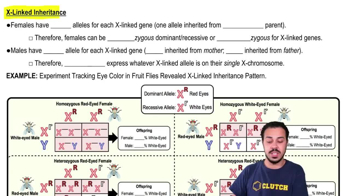
X-linked Recessive Inheritance
Color blindness is commonly inherited as an X-linked recessive trait, meaning the gene causing it is located on the X chromosome. Males (XY) with the defective gene on their single X chromosome express the trait, while females (XX) must have two copies to be affected. Females with one defective gene are carriers but usually have normal vision.
Recommended video:
 07:23
07:23
X-Linked Inheritance
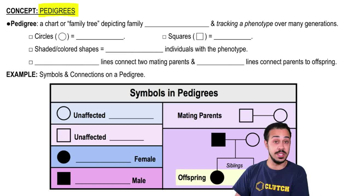
Pedigree Analysis and Carrier Status
Understanding the family history helps determine the mother's genotype. Since the woman’s father is color-blind, she must be a carrier (X^C X^c). This affects the probability calculations for their children’s genotypes and phenotypes, especially for sons who inherit their X chromosome from their mother.
Recommended video:
 02:36
02:36Pedigrees
Probability and Binomial Distribution
Calculating the chance of specific outcomes for multiple children involves probability rules and binomial distribution. For example, the probability of exactly two color-blind sons in four children requires combining the probability of each child being a color-blind son with the number of ways this can occur.
Recommended video:
 02:19
02:19Homogenous vs. Heterogenous Solutions
Related Practice