Ch. 29 Heredity

Hoehn, Haynes, Abbott12th EditionMarieb Human Anatomy & PhysiologyISBN: 9780138242732
Not the one you use?Change textbookSelect a different textbook
Table of contents
- Ch. 1 The Human Body: An Orientation25
- Ch. 2 Chemistry Comes Alive24
- Ch. 3 Cells: The Living Units24
- Ch. 4 Tissue: The Living Fabric19
- Ch. 5 The Integumentary System12
- Ch. 6 Bones and Skeletal Tissues19
- Ch. 7 The Skeleton14
- Ch. 8 Joints7
- Ch. 9 Muscles and Muscle Tissue26
- Ch. 10 The Muscular System25
- Ch. 11 Fundamentals of the Nervous System and Nervous Tissue23
- Ch. 12 The Central Nervous System25
- Ch. 13 The Peripheral Nervous System and Reflex Activity30
- Ch. 14 The Autonomic Nervous System16
- Ch. 15 The Special Senses26
- Ch. 16 The Endocrine System26
- Ch. 17 Blood27
- Ch. 18 The Cardiovascular System: The Heart25
- Ch. 19 The Cardiovascular System: Blood Vessels27
- Ch. 20 The Lymphatic System and Lymphoid Organs and Tissues16
- Ch. 21 The Immune System: Innate and Adaptive Body Defenses27
- Ch. 22 The Respiratory System21
- Ch. 23 The Digestive System31
- Ch. 24 Nutrition, Metabolism, and Energy Balance26
- Ch. 25 The Urinary System26
- Ch. 26 Fluid, Electrolyte, and Acid-Base Balance24
- Ch. 27 The Reproductive System24
- Ch. 28 Pregnancy and Human Development25
- Ch. 29 Heredity11
Hoehn, Haynes, Abbott12th EditionMarieb Human Anatomy & PhysiologyISBN: 9780138242732Not the one you use?Change textbook

Chapter 29, Problem 2
Match the following types of inheritance (key terms a–f) with
the descriptions below:
Key:
(a) dominant-recessive
(b) incomplete dominance
(c) multiple-allele
(d) polygene
(e) sex-linked
(f) extranuclear
____ (1) only sons show the trait
____ (2) homozygotes and heterozygotes have the same phenotype
____ (3) heterozygotes exhibit a phenotype intermediate between those of the homozygotes
____ (4) phenotypes of offspring may be more varied than
those of the parents
____ (5) inheritance of ABO blood types
____ (6) inheritance of stature
____ (7) reflects activity of mitochondrial DNA
 Verified step by step guidance
1
Step 1: Understand that sex-linked inheritance (e) typically affects only one sex, often males, because the gene is located on a sex chromosome (usually the X chromosome). Therefore, the description 'only sons show the trait' corresponds to (e) sex-linked.
Step 2: Recognize that in dominant-recessive inheritance (a), heterozygotes and homozygous dominants have the same phenotype because the dominant allele masks the recessive one. Thus, 'homozygotes and heterozygotes have the same phenotype' matches (a) dominant-recessive.
Step 3: In incomplete dominance (b), heterozygotes show an intermediate phenotype between the two homozygotes. So, 'heterozygotes exhibit a phenotype intermediate between those of the homozygotes' corresponds to (b) incomplete dominance.
Step 4: Multiple-allele inheritance (c) involves more than two alleles for a gene, leading to greater phenotypic variety among offspring than parents. Hence, 'phenotypes of offspring may be more varied than those of the parents' matches (c) multiple-allele.
Step 5: The inheritance of ABO blood types is a classic example of multiple alleles (A, B, and O), so 'inheritance of ABO blood types' also corresponds to (c) multiple-allele. For 'inheritance of stature,' which is influenced by many genes, this matches (d) polygene. Finally, 'reflects activity of mitochondrial DNA' refers to (f) extranuclear inheritance.
Key Concepts
Here are the essential concepts you must grasp in order to answer the question correctly.
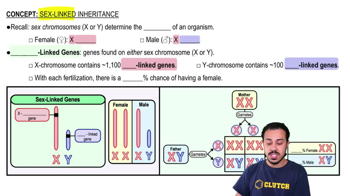
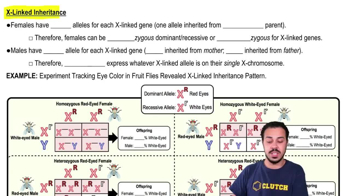
Sex-linked Inheritance
Sex-linked inheritance refers to genes located on sex chromosomes, often the X chromosome. Traits following this pattern typically appear more frequently in males, as they have only one X chromosome, so recessive alleles are expressed. An example is hemophilia, where only sons may show the trait if inherited from carrier mothers.
Recommended video:
 04:17
04:17
Sex-Linked Inheritance
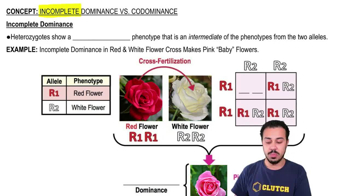
Incomplete Dominance
Incomplete dominance occurs when heterozygotes display a phenotype that is intermediate between the two homozygous forms. Unlike dominant-recessive inheritance, neither allele is completely dominant, resulting in blended traits, such as pink flowers from red and white parents.
Recommended video:
 03:09
03:09Incomplete Dominance
Multiple-Allele Inheritance
Multiple-allele inheritance involves more than two allele forms for a single gene within a population. This increases phenotypic variety, as seen in the ABO blood group system, where three alleles (A, B, O) combine to produce different blood types.
Recommended video:
 07:23
07:23X-Linked Inheritance
Related Practice