Ch. 7 The Skeleton
Hoehn - Marieb Human Anatomy & Physiology, 12th edition
Hoehn, Haynes, Abbott12th EditionMarieb Human Anatomy & PhysiologyISBN: 9780138242732Not the one you use?Change textbook
Chapter 7, Problem 14

Name the cranial and facial bones and compare and contrast the functions of the cranial and facial skeletons.

Verified step by step guidance
1
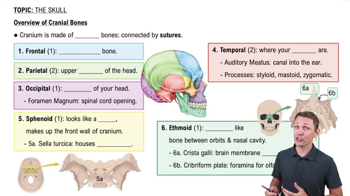
Step 1: Identify the cranial bones. The cranial bones form the protective case around the brain and include the frontal bone, two parietal bones, two temporal bones, the occipital bone, the sphenoid bone, and the ethmoid bone.
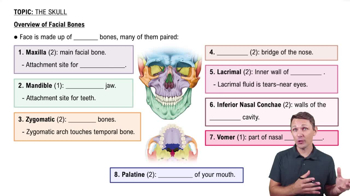
Step 2: Identify the facial bones. The facial bones provide structure to the face and support for the teeth and include the mandible, two maxillae, two zygomatic bones, two nasal bones, two lacrimal bones, two palatine bones, two inferior nasal conchae, and the vomer.
Step 3: Understand the function of the cranial skeleton. The cranial bones primarily protect the brain, support the structures of the head, and provide attachment points for muscles involved in head movement and chewing.
Step 4: Understand the function of the facial skeleton. The facial bones shape the face, protect the entrances to the digestive and respiratory systems, provide cavities for the sense organs (eyes, nose, mouth), and anchor the teeth and muscles of facial expression.
Step 5: Compare and contrast the two. While the cranial skeleton mainly serves a protective and supportive role for the brain, the facial skeleton is more involved in sensory functions, facial structure, and feeding mechanisms.

Verified video answer for a similar problem:

This video solution was recommended by our tutors as helpful for the problem above.
Video duration:
2m
Was this helpful?

Key Concepts

Here are the essential concepts you must grasp in order to answer the question correctly.

Cranial Bones

Cranial bones form the protective case around the brain. There are eight main cranial bones, including the frontal, parietal, temporal, occipital, sphenoid, and ethmoid bones. These bones provide structural support and protect the brain from injury.
Recommended video:
Guided course
8:20
Overview of Cranial Bones

Facial Bones

Facial bones shape the face and support the entrances to the digestive and respiratory systems. There are fourteen facial bones, such as the maxilla, mandible, nasal, zygomatic, and lacrimal bones. They provide structure for facial features and facilitate functions like chewing and breathing.
Recommended video:
Guided course
6:30
Overview of Facial Bones

Functional Differences Between Cranial and Facial Skeletons

The cranial skeleton primarily protects the brain and supports sensory organs, while the facial skeleton shapes the face and supports functions like mastication and respiration. Cranial bones are generally thicker and more robust, whereas facial bones are more varied in shape to accommodate facial features.
Recommended video:
Guided course
03:04
The Difference Between Anatomy and Physiology