Ch. 9 Muscles and Muscle Tissue
Hoehn - Marieb Human Anatomy & Physiology, 12th edition
Hoehn, Haynes, Abbott12th EditionMarieb Human Anatomy & PhysiologyISBN: 9780138242732Not the one you use?Change textbook
Chapter 9, Problem 26

Muscle-relaxing drugs are administered to a patient during major surgery. Which of the two chemicals described next would be a good skeletal muscle relaxant and why?
• Chemical A binds to and blocks ACh receptors of muscle cells.
• Chemical B floods the muscle cells' cytoplasm with Ca²⁺.

Verified step by step guidance
1
Step 1: Understand the role of acetylcholine (ACh) in skeletal muscle contraction. ACh is a neurotransmitter that binds to receptors on muscle cells, triggering a series of events that lead to muscle contraction.
Step 2: Analyze Chemical A, which binds to and blocks ACh receptors on muscle cells. Blocking these receptors prevents ACh from initiating muscle contraction, effectively causing muscle relaxation.
Step 3: Analyze Chemical B, which floods the muscle cell cytoplasm with Ca²⁺. Calcium ions inside muscle cells promote contraction by enabling the interaction between actin and myosin filaments.
Step 4: Compare the effects of both chemicals. Since Chemical A prevents the initiation of contraction by blocking ACh receptors, it acts as a muscle relaxant. Chemical B, by increasing intracellular Ca²⁺, would promote contraction rather than relaxation.
Step 5: Conclude that Chemical A would be a good skeletal muscle relaxant because it inhibits the signal for contraction, whereas Chemical B would not relax muscles but instead cause or enhance contraction.

Verified video answer for a similar problem:

This video solution was recommended by our tutors as helpful for the problem above.
Video duration:
2m
Was this helpful?

Key Concepts

Here are the essential concepts you must grasp in order to answer the question correctly.

Acetylcholine (ACh) Receptors and Neuromuscular Transmission

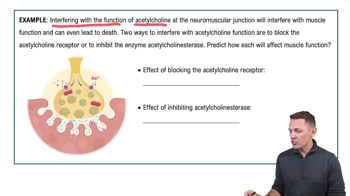
ACh receptors on muscle cells receive signals from motor neurons to trigger muscle contraction. Blocking these receptors prevents ACh from binding, stopping the signal and causing muscle relaxation. This mechanism is key for drugs that act as muscle relaxants during surgery.
Recommended video:
Guided course
3:26
Steps of Muscle Contraction Example 3

Role of Calcium Ions (Ca²⁺) in Muscle Contraction

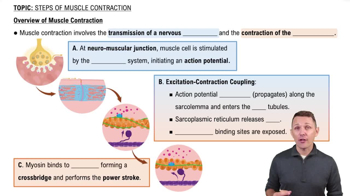
Calcium ions inside muscle cells initiate contraction by enabling interaction between actin and myosin filaments. Increasing cytoplasmic Ca²⁺ typically promotes contraction, so flooding muscle cells with Ca²⁺ would enhance, not relax, muscle activity.
Recommended video:
Guided course
4:53
Overview of Muscle Contraction

Mechanism of Skeletal Muscle Relaxants in Surgery

Skeletal muscle relaxants used in surgery often work by blocking neuromuscular transmission, either by inhibiting ACh receptors or preventing ACh release. Effective relaxants reduce muscle contractions to facilitate surgical procedures without affecting consciousness.
Recommended video:
Guided course
2:46
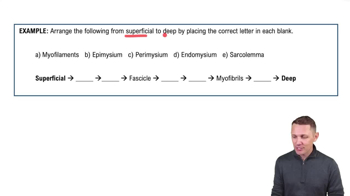
Structure of a Skeletal Muscle Example 2