Ch. 1 The Human Body: An Orientation
Marieb - Human Anatomy & Physiology 11th Edition
Marieb, Hoehn11th EditionHuman Anatomy & PhysiologyISBN: 9780136874034Not the one you use?Change textbook
Chapter 1, Problem 13

Provide the anatomical term that correctly names each of the following body regions:
a. Arm
b. Thigh
c. Chest
d. Fingers and toes
e. Anterior aspect of the knee

Verified step by step guidance
1
Step 1: Identify the anatomical term for the 'Arm'. The arm refers to the region between the shoulder and the elbow, which is called the 'brachial' region.
Step 2: Identify the anatomical term for the 'Thigh'. The thigh is the region between the hip and the knee, known as the 'femoral' region.
Step 3: Identify the anatomical term for the 'Chest'. The chest area is called the 'thoracic' region, which includes the area over the ribs and sternum.
Step 4: Identify the anatomical term for 'Fingers and toes'. Fingers are part of the 'digital' or 'phalangeal' region of the hand, and toes are part of the 'digital' or 'phalangeal' region of the foot.
Step 5: Identify the anatomical term for the 'Anterior aspect of the knee'. The front part of the knee is called the 'patellar' region.

Verified video answer for a similar problem:

This video solution was recommended by our tutors as helpful for the problem above.
Video duration:
2m
Was this helpful?

Key Concepts

Here are the essential concepts you must grasp in order to answer the question correctly.

Anatomical Terminology of Body Regions

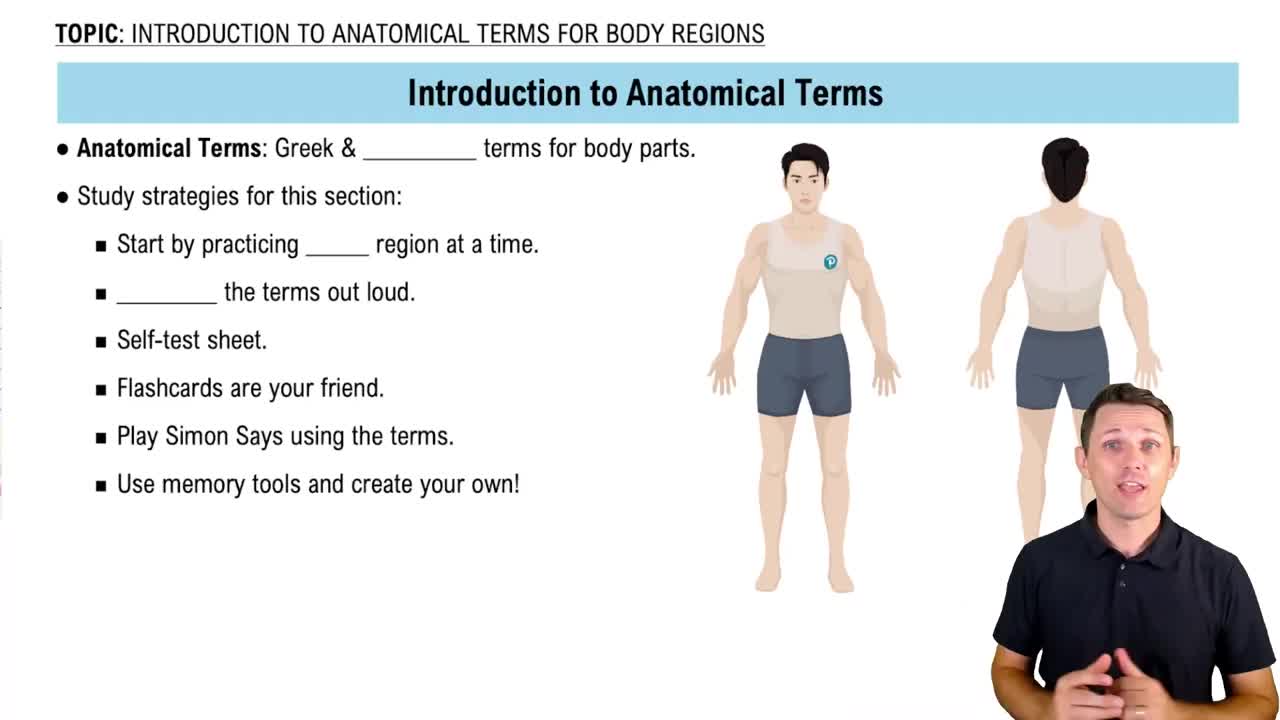
Anatomical terminology provides specific names for different parts of the body to avoid confusion. For example, the arm is referred to as the 'brachial' region, the thigh as the 'femoral' region, and the chest as the 'thoracic' region. Fingers and toes are called 'digital' or 'phalangeal,' while the anterior aspect of the knee is known as the 'patellar' region.
Recommended video:
Guided course
03:21
Introduction to Anatomical Terms

Directional Terms in Anatomy

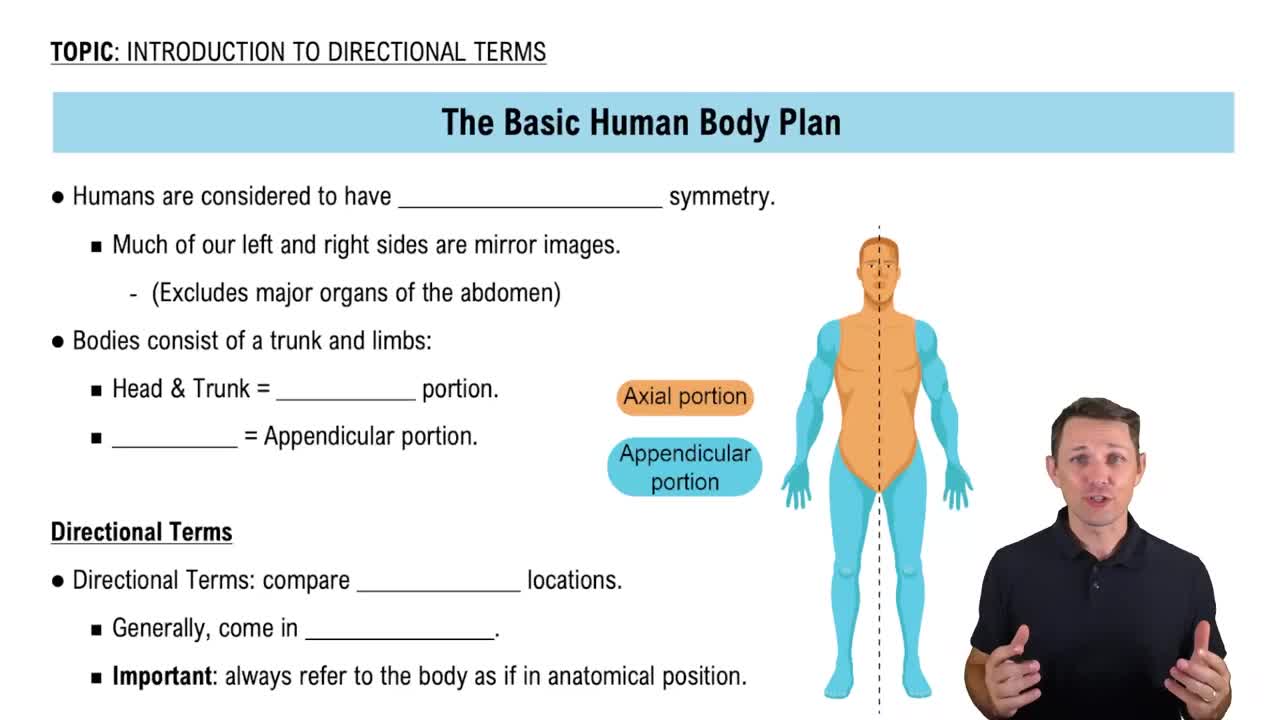
Directional terms describe the location of body parts relative to each other. Terms like medial (toward the midline), lateral (away from the midline), proximal (closer to the trunk), and distal (farther from the trunk) help specify exact locations. These terms are essential for accurately identifying and naming body regions.
Recommended video:
Guided course
03:00
Introduction to Directional Terms

Body Planes and Midline Reference

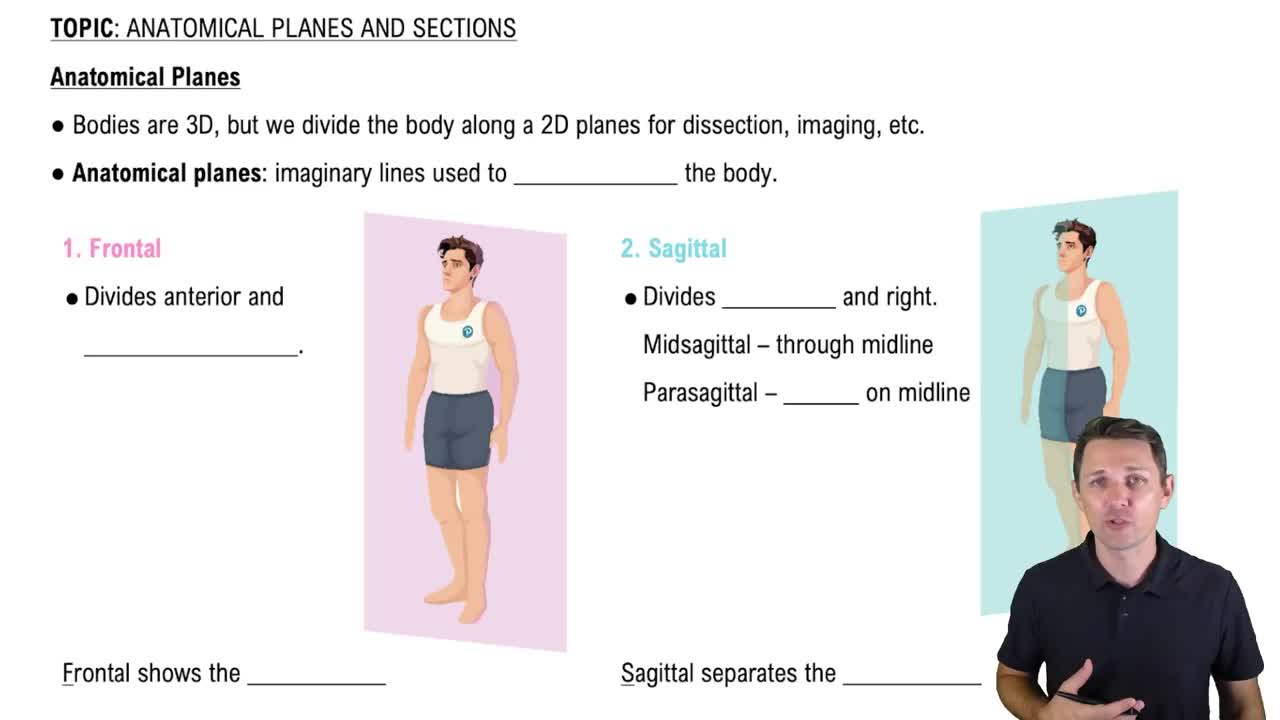
The midline divides the body into right and left halves and serves as a reference for medial and lateral directions. Understanding this helps in identifying the position of body regions, such as the anterior (front) aspect of the knee, which lies in front of the midline plane. This concept is crucial for precise anatomical descriptions.
Recommended video:
Guided course
04:01
Anatomical Planes