Differentiate between the arrangement of elements (load, fulcrum, and effort) in first-, second-, and third-class levers.
Ch. 10 The Muscular System

Marieb, Hoehn11th EditionHuman Anatomy & PhysiologyISBN: 9780136874034Not the one you use?Change textbook
Chapter 10, Problem 16
a. Name two forearm muscles that are powerful extensors and abductors of the hand.
b. Name the sole forearm muscle that can flex the distal interphalangeal joints.
Verified step by step guidance1
For part (a), recall that forearm muscles involved in extension and abduction of the hand are primarily located in the posterior compartment of the forearm. Identify muscles that extend the wrist and also abduct the hand (move it away from the midline).
Two key muscles that fit this description are the extensor carpi radialis longus and extensor carpi radialis brevis. Both are powerful wrist extensors and contribute to abduction of the hand.
For part (b), focus on the muscles that flex the fingers, specifically those that can flex the distal interphalangeal (DIP) joints, which are the joints closest to the fingertips.
The sole forearm muscle capable of flexing the DIP joints is the flexor digitorum profundus. This muscle inserts on the distal phalanges and allows flexion at the DIP joints.
Summarize your answers by naming the two muscles for part (a) and the single muscle for part (b), ensuring you understand their anatomical locations and functions.

Verified video answer for a similar problem:
This video solution was recommended by our tutors as helpful for the problem above.
Video duration:
2mWas this helpful?
Key Concepts
Here are the essential concepts you must grasp in order to answer the question correctly.
Forearm Muscle Functions
Forearm muscles control movements of the wrist, hand, and fingers. Extensors increase the angle at joints (extension), while abductors move the hand away from the midline. Understanding these functions helps identify muscles responsible for specific hand movements.
Recommended video:
Functional Groups
Extensor and Abductor Muscles of the Hand
Muscles like the extensor carpi radialis longus and brevis are powerful extensors and abductors of the hand. They extend the wrist and move the hand laterally, playing key roles in hand positioning and grip.
Recommended video:
Guided course
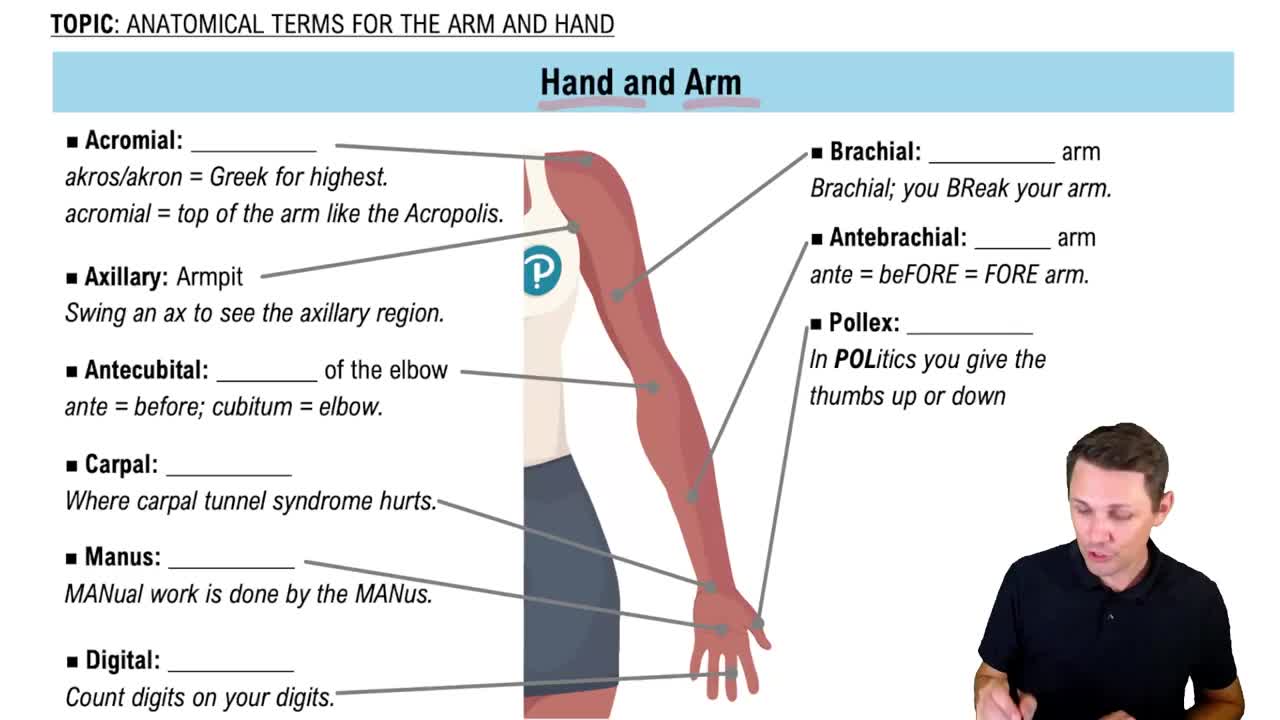
The Arm and Hand
Flexion of Distal Interphalangeal Joints
The flexor digitorum profundus is the sole forearm muscle that flexes the distal interphalangeal joints of the fingers. This deep muscle allows bending of the fingertip joints, essential for fine motor skills like gripping small objects.
Recommended video:
Structural Joint Classifications
Related Practice
Textbook Question
1050
views
Textbook Question
Which muscles act to propel food down the length of the pharynx to the esophagus?
974
views
Textbook Question
Name four criteria used in naming muscles, and provide an example (other than those used in the text) that illustrates each criterion.
1410
views
Textbook Question
Which of the following is a large, deep muscle that protracts the scapula during punching?
a. Serratus anterior
b. Rhomboids
c. Levator scapulae
d. Subscapularis
1031
views
Textbook Question
a. Name the four muscle pairs that act in unison to compress the abdominal contents.
b. How does their arrangement (fiber direction) contribute to the strength of the abdominal wall?
c. Which of these muscles can effect lateral rotation of the spine?
d. Which can act alone to flex the spine?
1041
views
Textbook Question
Name and describe the action of muscles used to shake your head no; to nod yes.
1375
views