Ch. 12 The Central Nervous System
Marieb - Human Anatomy & Physiology 11th Edition
Marieb, Hoehn11th EditionHuman Anatomy & PhysiologyISBN: 9780136874034Not the one you use?Change textbook
Chapter 12, Problem 22

Mrs. Jones has had a progressive decline in her mental capabilities in the last five or six years. At first her family attributed her occasional memory lapses, confusion, and agitation to grief over her husband's death six years earlier. When examined, Mrs. Jones was aware of her cognitive problems and was shown to have an IQ score approximately 30 points less than would be predicted by her work history. A CT scan showed diffuse cerebral atrophy. The physician prescribed an acetylcholinesterase inhibitor and Mrs. Jones showed slight improvement. What is Mrs. Jones's problem? Why did the acetylcholinesterase inhibitor help?

Verified step by step guidance
1
Step 1: Identify the key symptoms and clinical findings. Mrs. Jones has progressive cognitive decline over several years, memory lapses, confusion, agitation, and a significant drop in IQ score compared to her previous baseline. A CT scan shows diffuse cerebral atrophy, indicating widespread brain tissue loss.
Step 2: Recognize the likely diagnosis. Progressive cognitive decline with memory impairment, cerebral atrophy on imaging, and gradual worsening over years is characteristic of Alzheimer's disease, a neurodegenerative disorder affecting memory and cognition.
Step 3: Understand the role of acetylcholinesterase inhibitors. These drugs inhibit the enzyme acetylcholinesterase, which breaks down acetylcholine, a neurotransmitter important for learning and memory. By inhibiting this enzyme, acetylcholine levels increase in the brain.
Step 4: Explain why the acetylcholinesterase inhibitor helps. In Alzheimer's disease, there is a loss of cholinergic neurons leading to decreased acetylcholine. Increasing acetylcholine availability can temporarily improve cognitive function and slow symptom progression.
Step 5: Summarize the problem and treatment rationale. Mrs. Jones likely has Alzheimer's disease causing her cognitive decline and brain atrophy. The acetylcholinesterase inhibitor helps by enhancing cholinergic neurotransmission, which partially compensates for the loss of acetylcholine-producing neurons.

Verified video answer for a similar problem:

This video solution was recommended by our tutors as helpful for the problem above.
Video duration:
2m
Was this helpful?

Key Concepts

Here are the essential concepts you must grasp in order to answer the question correctly.

Alzheimer's Disease and Dementia

Alzheimer's disease is a progressive neurodegenerative disorder characterized by memory loss, cognitive decline, and behavioral changes. It is the most common cause of dementia in older adults, often presenting with symptoms like confusion and agitation. Diffuse cerebral atrophy seen on imaging supports this diagnosis by indicating brain tissue loss.
Recommended video:
3:19
Immune Tolerance

Role of Acetylcholine in Cognition

Acetylcholine is a neurotransmitter crucial for learning and memory processes in the brain. In Alzheimer's disease, cholinergic neurons degenerate, leading to decreased acetylcholine levels. Enhancing acetylcholine availability can improve cognitive function temporarily by supporting neural communication.
Recommended video:
Guided course
5:56
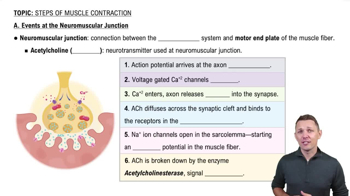
A. Events at the Neuromuscular Junction

Mechanism of Acetylcholinesterase Inhibitors

Acetylcholinesterase inhibitors block the enzyme that breaks down acetylcholine, increasing its concentration in synapses. This helps compensate for the loss of cholinergic neurons in Alzheimer's disease, leading to modest improvements in memory and cognition, as seen in Mrs. Jones's slight improvement after treatment.
Recommended video:
3:02
Internal Regulation - The Myogenic Mechanism