Ch. 15 The Special Senses
Marieb - Human Anatomy & Physiology 11th Edition
Marieb, Hoehn11th EditionHuman Anatomy & PhysiologyISBN: 9780136874034Not the one you use?Change textbook
Chapter 15, Problem 1

Accessory glands that produce an oily secretion are the
a. Conjunctiva
b. Lacrimal glands
c. Tarsal glands

Verified step by step guidance
1
Step 1: Understand the function of each gland mentioned in the options. The conjunctiva is a membrane that covers the front of the eye and lines the inside of the eyelids, but it does not produce oily secretions.
Step 2: Recognize that lacrimal glands are responsible for producing tears, which are primarily watery and help lubricate the eye surface, but they do not produce oily secretions.
Step 3: Identify that tarsal glands, also known as Meibomian glands, are specialized sebaceous glands located in the eyelids that secrete an oily substance.
Step 4: Understand the role of the oily secretion from the tarsal glands, which is to prevent evaporation of the eye's tear film and keep the eyes lubricated.
Step 5: Conclude that the accessory glands producing an oily secretion are the tarsal glands, based on their anatomical location and function.

Verified video answer for a similar problem:

This video solution was recommended by our tutors as helpful for the problem above.
Video duration:
2m
Was this helpful?

Key Concepts

Here are the essential concepts you must grasp in order to answer the question correctly.

Accessory glands of the eye

Accessory glands are structures associated with the eye that produce secretions to protect and maintain the eye's surface. They include glands like the lacrimal glands, which produce tears, and the tarsal glands, which secrete oils to prevent tear evaporation.
Recommended video:
3:21
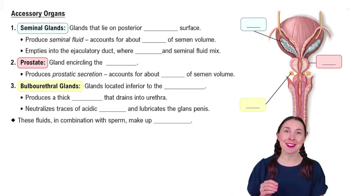
Accessory Organs

Tarsal glands (Meibomian glands)

Tarsal glands are specialized sebaceous glands located along the edges of the eyelids. They produce an oily secretion that lubricates the eye surface and prevents the evaporation of the tear film, helping maintain eye moisture and comfort.
Recommended video:
Guided course
7:10
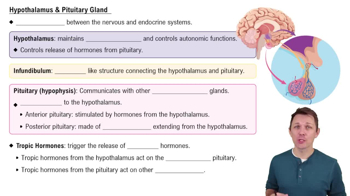
Hypothalamus & Pituitary Gland

Lacrimal glands and conjunctiva

Lacrimal glands produce watery tears that cleanse and moisten the eye, while the conjunctiva is a membrane covering the eye and inner eyelids, contributing to eye protection but not producing oily secretions. Understanding their roles helps differentiate the source of eye secretions.
Recommended video:
Guided course
7:10
Hypothalamus & Pituitary Gland