Ch. 17 Blood
Marieb - Human Anatomy & Physiology 11th Edition
Marieb, Hoehn11th EditionHuman Anatomy & PhysiologyISBN: 9780136874034Not the one you use?Change textbook
Chapter 17, Problem 20

How can poor nutrition lead to anemia?

Verified step by step guidance
1
Step 1: Understand that anemia is a condition characterized by a decreased number of red blood cells or hemoglobin, which reduces the blood's ability to carry oxygen to tissues.
Step 2: Recognize that proper nutrition provides essential nutrients like iron, vitamin B12, and folic acid, which are critical for the production and maturation of red blood cells.
Step 3: Identify that poor nutrition can lead to deficiencies in these key nutrients, impairing hemoglobin synthesis and red blood cell formation.
Step 4: Note that iron deficiency anemia occurs when there is insufficient iron intake or absorption, leading to smaller and fewer red blood cells.
Step 5: Understand that deficiencies in vitamin B12 or folic acid cause megaloblastic anemia, where red blood cells are abnormally large and immature, further reducing oxygen transport efficiency.

Verified video answer for a similar problem:

This video solution was recommended by our tutors as helpful for the problem above.
Video duration:
3m
Was this helpful?

Key Concepts

Here are the essential concepts you must grasp in order to answer the question correctly.

Role of Nutrients in Red Blood Cell Production

Certain nutrients like iron, vitamin B12, and folate are essential for producing healthy red blood cells. Deficiencies in these nutrients impair hemoglobin synthesis and red blood cell formation, leading to anemia.
Recommended video:
6:11
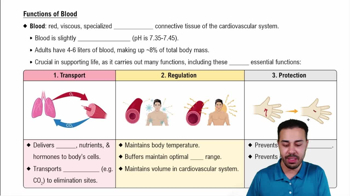
Functions of Blood

Types of Nutritional Anemia

Nutritional anemia includes iron-deficiency anemia, megaloblastic anemia (due to B12 or folate deficiency), and others. Each type results from lacking specific nutrients necessary for red blood cell health and function.
Recommended video:
3:00
Types-Of-Phosphorylation-C-2-V-1

Impact of Poor Nutrition on Oxygen Transport

Anemia reduces the blood’s capacity to carry oxygen to tissues, causing fatigue and weakness. Poor nutrition limits the body's ability to produce adequate hemoglobin, directly affecting oxygen delivery and overall health.
Recommended video:
02:37
Active Transport
Related Practice
Textbook Question

Describe the appearance of platelets and state their major function

Why should platelets not be called 'cells'?

1322
views
Textbook Question

Cancer patients being treated with chemotherapeutic drugs designed to destroy rapidly dividing cells are monitored closely for changes in their red and white blood counts. Why so?

1057
views
Textbook Question

Define fibrinolysis

What is the importance of this process?

909
views
Textbook Question

Define hemostasis

List the three major phases of coagulation. Explain what initiates each phase and what the phase accomplishes

In what general way do the intrinsic and extrinsic mechanisms of clotting differ?

Which ion is essential to virtually all stages of coagulation?

1117
views
Textbook Question

How is clot overgrowth usually prevented?

List two conditions that may lead to unnecessary (and undesirable) clot formation.

707
views
Textbook Question

Alan Forsythe, a middle-aged college professor from Boston, is in the Swiss Alps studying astronomy during his sabbatical leave. He has been there for two days and plans to stay the entire year. However, he notices that he is short of breath when he walks up steps and tires easily with any physical activity. His symptoms gradually disappear, and he feels fine after less than a month. Upon returning to the United States, he has a complete physical exam and is told that his erythrocyte count is higher than normal.

a. Attempt to explain this finding.

b. Will his RBC count remain at this higher-than-normal level? Why or why not?

762
views