
Textbook Question
Physiologists often consider capillaries and postcapillary venules together.
a. What functions do these vessels share?
b. Structurally, how do they differ?
1209
views

 Verified step by step guidance
 6:40
6:40
 4:59
4:59 6:24
6:24Physiologists often consider capillaries and postcapillary venules together.
a. What functions do these vessels share?
b. Structurally, how do they differ?
How does the control of blood flow to the skin for the purpose of regulating body temperature differ from the control of nutrient blood flow to skin cells?
A 60-year-old man is unable to walk more than 100 yards without experiencing severe pain in his left leg; the pain is relieved by resting for 5–10 minutes. He is told that the arteries of his leg are becoming occluded with fatty material and is advised to have the sympathetic nerves serving that body region severed. Explain how such surgery might help to relieve this man's problem.
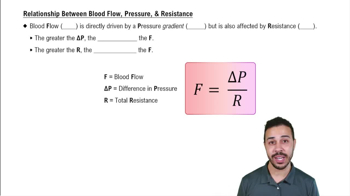
Write an equation showing the relationship between total peripheral resistance, blood flow, and blood pressure.
Distinguish between elastic arteries, muscular arteries, and arterioles relative to location, histology, and functional adaptations.
Describe neural and chemical (both systemic and local) effects exerted on the blood vessels when you are fleeing from a mugger. (Be careful, this is more involved than it appears at first glance.)