Ch. 21 The Immune System: Innate and Adaptive Body Defenses
Marieb - Human Anatomy & Physiology 11th Edition
Marieb, Hoehn11th EditionHuman Anatomy & PhysiologyISBN: 9780136874034Not the one you use?Change textbook
Chapter 21, Problem 26

Isabella, a 6-year-old child who has been raised in a germ-free environment from birth, has one of the most severe examples of an abnormal immune system. Isabella also suffers from cancer caused by the Epstein-Barr virus. Relative to this case:


a. Why is Isabella’s brother chosen as the hematopoietic stem cell donor?
b. Why is her physician planning to use umbilical cord blood as a source of stem cells for transplant if her brother’s stem cells fail (what are the hoped-for results)?
c. Attempt to explain Isabella’s cancer.
d. What similarities and dissimilarities exist between Isabella’s illness and AIDS?

Verified step by step guidance
1
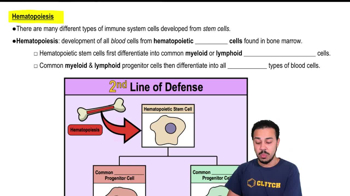
Step 1: Understand the role of hematopoietic stem cells (HSCs) in immune system function. These stem cells give rise to all blood cells, including immune cells like T cells and B cells. Since Isabella has a severe immune deficiency, replacing her defective immune system with healthy HSCs can restore immune function. Her brother is chosen as the donor because a close genetic match (usually a sibling) reduces the risk of transplant rejection and graft-versus-host disease.
Step 2: Explain why umbilical cord blood is considered as an alternative source of stem cells. Umbilical cord blood contains a rich supply of hematopoietic stem cells that are more immunologically naive, meaning they are less likely to cause rejection. If the brother’s stem cells fail, cord blood can provide a backup source to reconstitute Isabella’s immune system, with hopes of successful engraftment and immune recovery.
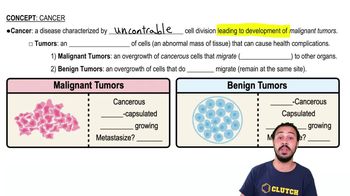
Step 3: Analyze the cause of Isabella’s cancer in the context of her immune deficiency. The Epstein-Barr virus (EBV) is normally controlled by a healthy immune system. In Isabella’s case, her impaired immunity allows EBV to persist and potentially transform infected cells into cancerous ones, such as lymphomas. This illustrates how immune surveillance prevents virus-induced cancers.
Step 4: Compare Isabella’s illness with AIDS by identifying similarities and differences. Both conditions involve severe immune system impairment leading to vulnerability to infections and cancers. However, AIDS is caused by HIV infection that directly targets immune cells, whereas Isabella’s condition is likely a genetic or developmental immune deficiency. The mechanisms and origins differ, but the consequences on immune function show parallels.
Step 5: Summarize the clinical importance of stem cell transplantation and immune reconstitution in treating severe immune deficiencies and associated complications like virus-induced cancers. This highlights the interconnectedness of immune system health, infection control, and cancer prevention.

Key Concepts

Here are the essential concepts you must grasp in order to answer the question correctly.

Hematopoietic Stem Cell Transplantation (HSCT)

HSCT involves replacing damaged or defective bone marrow with healthy stem cells capable of producing new blood and immune cells. A sibling donor is often chosen due to higher genetic compatibility, reducing the risk of transplant rejection and graft-versus-host disease. This procedure is critical for treating severe immune deficiencies and certain cancers.
Recommended video:
2:33
Hematopoeisis

Umbilical Cord Blood as a Stem Cell Source

Umbilical cord blood contains hematopoietic stem cells that can regenerate the immune system. It is used as an alternative donor source when a matched sibling donor is unavailable or fails. Cord blood stem cells are more immunologically naive, which can lower rejection risk and improve transplant success in immune-compromised patients.
Recommended video:
6:11
Functions of Blood

Immune Deficiency and Virus-Induced Cancer

Severe immune deficiencies impair the body's ability to fight infections and control oncogenic viruses like Epstein-Barr virus (EBV). EBV can cause cancers such as lymphomas when immune surveillance is compromised. This explains how immune defects can lead to virus-associated malignancies, similar to mechanisms seen in AIDS-related cancers.
Recommended video:
03:22
Cancer