Ch. 21 The Immune System: Innate and Adaptive Body Defenses
Marieb - Human Anatomy & Physiology 11th Edition
Marieb, Hoehn11th EditionHuman Anatomy & PhysiologyISBN: 9780136874034Not the one you use?Change textbook
Chapter 21, Problem 8

Which of the following is not involved in the activation of a B cell?
a. Antigen
b. Helper T cell
c. Cytokine
d. Cytotoxic T cell

Verified step by step guidance
1
Step 1: Understand the role of B cells in the immune response. B cells are responsible for producing antibodies and require activation to perform this function effectively.
Step 2: Identify the components involved in B cell activation. Typically, B cell activation involves recognition of an antigen, assistance from helper T cells, and signaling molecules such as cytokines.
Step 3: Analyze the role of each option: Antigen binds directly to the B cell receptor to initiate activation; Helper T cells provide necessary co-stimulation; Cytokines are signaling molecules that promote B cell proliferation and differentiation.
Step 4: Consider the role of cytotoxic T cells. Cytotoxic T cells primarily kill infected cells and are not directly involved in the activation of B cells.
Step 5: Conclude that the component not involved in B cell activation is the cytotoxic T cell, as it does not contribute to the activation process of B cells.

Verified video answer for a similar problem:

This video solution was recommended by our tutors as helpful for the problem above.
Video duration:
3m
Was this helpful?

Key Concepts

Here are the essential concepts you must grasp in order to answer the question correctly.

B Cell Activation

B cell activation is the process by which B lymphocytes respond to antigens, leading to their proliferation and differentiation into antibody-producing plasma cells. This activation typically requires antigen recognition and additional signals from helper T cells and cytokines.
Recommended video:
4:37
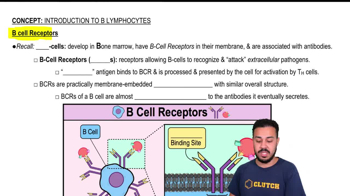
B Cell Receptors

Role of Helper T Cells in B Cell Activation

Helper T cells assist B cell activation by recognizing antigen-presenting B cells and providing essential co-stimulatory signals and cytokines. This interaction is crucial for effective antibody production and class switching.
Recommended video:
4:27
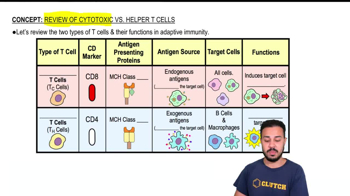
Review of Cytotoxic vs Helper T Cells

Function of Cytotoxic T Cells

Cytotoxic T cells primarily target and kill infected or abnormal cells by recognizing antigen fragments presented on MHC class I molecules. They do not play a direct role in activating B cells during the immune response.
Recommended video:
6:21
Functions of Cytotoxic T Cells