Ch. 22 The Respiratory System
Marieb - Human Anatomy & Physiology 11th Edition
Marieb, Hoehn11th EditionHuman Anatomy & PhysiologyISBN: 9780136874034Not the one you use?Change textbook
Chapter 22, Problem 19

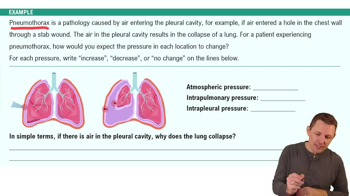
A member of the 'Blues' gang was rushed into an emergency room after receiving a knife wound in the left side of his thorax. The diagnosis was pneumothorax and a collapsed lung. Explain exactly
Why the lung collapsed?
Why only one lung (not both) collapsed?

Verified step by step guidance
1
Step 1: Understand the anatomy of the thoracic cavity, which contains two separate pleural cavities, each surrounding one lung. Each lung is enclosed by its own pleura, a double-layered membrane consisting of the visceral pleura (attached to the lung) and the parietal pleura (attached to the chest wall).
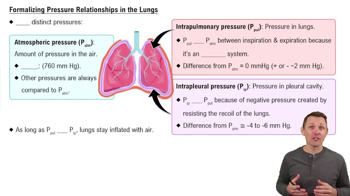
Step 2: Recognize that the pleural cavity normally contains a small amount of pleural fluid and maintains a negative pressure relative to atmospheric pressure. This negative pressure keeps the lungs inflated by creating a suction effect that holds the lung tissue against the chest wall.
Step 3: When the knife wound punctures the left side of the thorax, air enters the pleural cavity on that side (a condition called pneumothorax). This air disrupts the negative pressure, causing the lung on that side to lose the suction force that keeps it expanded.
Step 4: Because the negative pressure is lost only in the pleural cavity on the injured side, only the left lung collapses. The right lung remains inflated because its pleural cavity is intact and maintains its negative pressure.
Step 5: Summarize that the lung collapses due to loss of negative intrapleural pressure caused by air entering the pleural space, and only one lung collapses because the pleural cavities are separate, so injury to one side does not affect the other.

Verified video answer for a similar problem:

This video solution was recommended by our tutors as helpful for the problem above.
Video duration:
3m
Was this helpful?

Key Concepts

Here are the essential concepts you must grasp in order to answer the question correctly.

Pneumothorax and Lung Collapse

Pneumothorax occurs when air enters the pleural cavity, the space between the lung and chest wall, disrupting the negative pressure that keeps the lung inflated. This loss of pressure causes the lung to collapse partially or completely because it can no longer expand during inhalation.
Recommended video:
Guided course
4:01
Pressure in the Lungs and Pleural Cavity Example 2

Anatomy of the Pleural Cavities

Each lung is enclosed in its own pleural cavity, separated by the mediastinum. Because these cavities are independent, damage to one side (such as a knife wound) affects only that lung, preventing air from entering the opposite pleural space and causing collapse of the other lung.
Recommended video:
Guided course
4:01
Pressure in the Lungs and Pleural Cavity Example 2

Mechanism of Lung Inflation and Negative Pressure

Normally, the pleural cavity maintains a negative pressure relative to atmospheric pressure, which keeps the lungs expanded. When this pressure is lost due to injury, the elastic recoil of the lung tissue causes it to shrink, leading to lung collapse on the affected side.
Recommended video:
Guided course
5:46
Formalizing Pressure Relationships in the Lungs