Ch. 24 Nutrition, Metabolism, and Energy Balance
Marieb - Human Anatomy & Physiology 11th Edition
Marieb, Hoehn11th EditionHuman Anatomy & PhysiologyISBN: 9780136874034Not the one you use?Change textbook
Chapter 24, Problem 3

The net gain of ATP from the complete metabolism (aerobic) of glucose is closest to:
a. 2
b. 30
c. 3
d. 4

Verified step by step guidance
1
Step 1: Understand the process of aerobic metabolism of glucose, which includes glycolysis, the citric acid cycle (Krebs cycle), and oxidative phosphorylation. Each of these stages contributes to ATP production.
Step 2: Recall that glycolysis occurs in the cytoplasm and breaks down one molecule of glucose into two molecules of pyruvate, producing a net gain of 2 ATP molecules and 2 NADH molecules.
Step 3: Pyruvate is converted into acetyl-CoA, which enters the citric acid cycle. Each turn of the cycle generates 1 ATP (or GTP), 3 NADH, and 1 FADH₂ per acetyl-CoA. Since one glucose molecule produces two acetyl-CoA molecules, the cycle runs twice per glucose molecule.
Step 4: NADH and FADH₂ produced during glycolysis, pyruvate conversion, and the citric acid cycle are used in oxidative phosphorylation. Each NADH contributes approximately 2.5 ATP, and each FADH₂ contributes approximately 1.5 ATP during electron transport and chemiosmosis.
Step 5: Add up the ATP contributions from glycolysis, the citric acid cycle, and oxidative phosphorylation to determine the net gain of ATP from the complete aerobic metabolism of one glucose molecule. Consider the energy costs of transporting NADH from glycolysis into the mitochondria if applicable.

Verified video answer for a similar problem:

This video solution was recommended by our tutors as helpful for the problem above.
Video duration:
1m
Was this helpful?

Key Concepts

Here are the essential concepts you must grasp in order to answer the question correctly.

Cellular Respiration

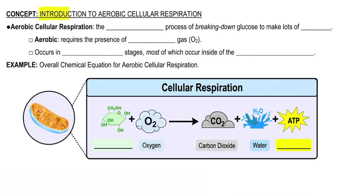
Cellular respiration is the metabolic process by which cells convert glucose and oxygen into energy, carbon dioxide, and water. This process occurs in several stages, including glycolysis, the Krebs cycle, and oxidative phosphorylation, ultimately leading to the production of ATP, the energy currency of the cell.
Recommended video:
03:38
Introduction to Cellular Respiration

ATP Yield from Glucose

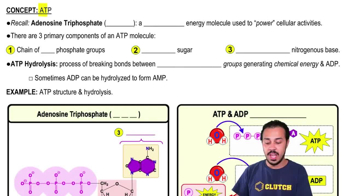
The complete aerobic metabolism of one molecule of glucose typically yields about 30 to 32 molecules of ATP. This high yield is achieved through the efficient use of electron transport chains and chemiosmosis, where the energy from electrons is used to pump protons across a membrane, creating a gradient that drives ATP synthesis.
Recommended video:

Glycolysis and Krebs Cycle

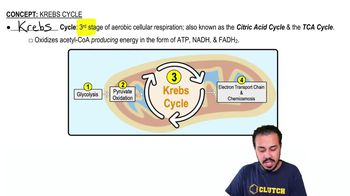
Glycolysis is the first step in glucose metabolism, occurring in the cytoplasm, where glucose is broken down into pyruvate, yielding a small amount of ATP and NADH. The Krebs cycle, occurring in the mitochondria, further processes pyruvate, producing additional NADH and FADH2, which are crucial for the electron transport chain and contribute to the overall ATP yield.
Recommended video:
01:37
Krebs Cycle