Ch. 29 Heredity

Marieb, Hoehn11th EditionHuman Anatomy & PhysiologyISBN: 9780136874034
Not the one you use?Change textbookSelect a different textbook
Table of contents
- Ch. 1 The Human Body: An Orientation24
- Ch. 2 Chemistry Comes Alive25
- Ch. 3 Cells: The Living Units21
- Ch. 4 Tissue: The Living Fabric20
- Ch. 5 The Integumentary System11
- Ch. 6 Bones and Skeletal Tissues19
- Ch. 7 The Skeleton14
- Ch. 8 Joints7
- Ch. 9 Muscles and Muscle Tissue26
- Ch. 10 The Muscular System26
- Ch. 11 Fundamentals of the Nervous System and Nervous Tissue19
- Ch. 12 The Central Nervous System26
- Ch. 13 The Peripheral Nervous System and Reflex Activity32
- Ch. 14 The Autonomic Nervous System19
- Ch. 15 The Special Senses26
- Ch. 16 The Endocrine System23
- Ch. 17 Blood25
- Ch. 18 The Cardiovascular System: The Heart24
- Ch. 19 The Cardiovascular System: Blood Vessels27
- Ch. 20 The Lymphatic System and Lymphoid Organs and Tissues14
- Ch. 21 The Immune System: Innate and Adaptive Body Defenses27
- Ch. 22 The Respiratory System21
- Ch. 23 The Digestive System31
- Ch. 24 Nutrition, Metabolism, and Energy Balance26
- Ch. 25 The Urinary System26
- Ch. 26 Fluid, Electrolyte, and Acid-Base Balance24
- Ch. 27 The Reproductive System24
- Ch. 28 Pregnancy and Human Development25
- Ch. 29 Heredity11
Marieb, Hoehn11th EditionHuman Anatomy & PhysiologyISBN: 9780136874034Not the one you use?Change textbook

Chapter 29, Problem 7
In skin color inheritance, what will be the relative range of pigmentation in offspring arising from the following parental matches?
(a) AABBCC × aabbcc
(b) AABBCC × AaBbCc
(c) Aabbcc × aabbcc
 Verified step by step guidance
1
Step 1: Understand the genetic basis of skin color inheritance in this problem. Each gene (A, B, C) contributes additively to pigmentation, with uppercase alleles (A, B, C) representing dominant alleles that increase pigmentation, and lowercase alleles (a, b, c) representing recessive alleles that do not contribute to pigmentation. The total pigmentation is the sum of dominant alleles present.
Step 2: For each parental genotype pair, determine the possible genotypes of the offspring by performing a Punnett square analysis for each gene separately (A, B, and C). This will help identify the combinations of dominant and recessive alleles the offspring can inherit.
Step 3: Calculate the number of dominant alleles in each possible offspring genotype. For example, an offspring with genotype AaBbCc has three dominant alleles (one from each gene), while aabbcc has zero dominant alleles.
Step 4: Determine the range of pigmentation in the offspring by identifying the minimum and maximum number of dominant alleles possible from the crosses. This range reflects the relative pigmentation levels, with more dominant alleles indicating darker pigmentation.
Step 5: Summarize the relative pigmentation range for each parental cross by listing the minimum and maximum number of dominant alleles the offspring can inherit, which corresponds to the lightest and darkest possible skin pigmentation in the offspring.
Key Concepts
Here are the essential concepts you must grasp in order to answer the question correctly.
Polygenic Inheritance
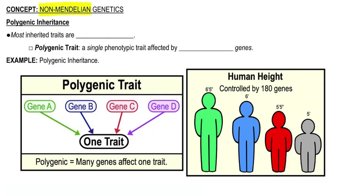
Polygenic inheritance refers to a trait controlled by multiple genes, each contributing to the phenotype. Skin color is a classic example, where several gene pairs (like A, B, C) influence pigmentation, resulting in a continuous range of skin tones rather than discrete categories.
Recommended video:
 02:27
02:27
Polygenic Inheritance
Allelic Interaction and Dominance
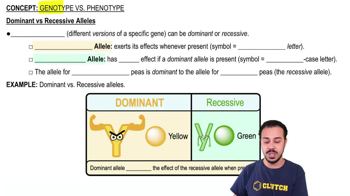
Allelic interaction involves how dominant and recessive alleles at each gene locus affect the trait. Dominant alleles (e.g., A, B, C) typically add to pigmentation, while recessive alleles (a, b, c) contribute less or none, influencing the overall skin color intensity in offspring.
Recommended video:
 03:39
03:39Dominant vs. Recessive Alleles
Genotypic Combinations and Phenotypic Range
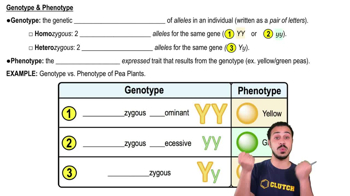
The combination of parental genotypes determines the possible genotypes and phenotypes of offspring. Crosses between homozygous dominant and homozygous recessive parents produce uniform offspring, while crosses involving heterozygotes generate a wider range of pigmentation due to varied allele combinations.
Recommended video:
 06:36
06:36Genotype & Phenotype
Related Practice