Ch. 4 Tissue: The Living Fabric
Marieb - Human Anatomy & Physiology 11th Edition
Marieb, Hoehn11th EditionHuman Anatomy & PhysiologyISBN: 9780136874034Not the one you use?Change textbook
Chapter 4, Problem 20

Compare and contrast skeletal, cardiac, and smooth muscle tissue relative to structure, body location, and specific function.

Verified step by step guidance
1
Begin by identifying the structural characteristics of each muscle type: skeletal muscle is striated and multinucleated with long cylindrical fibers; cardiac muscle is also striated but has branched fibers with intercalated discs; smooth muscle is non-striated with spindle-shaped cells containing a single nucleus.
Next, describe the typical body locations where each muscle type is found: skeletal muscle attaches to bones and is responsible for voluntary movements; cardiac muscle is found exclusively in the heart wall; smooth muscle is located in walls of hollow organs such as blood vessels, the digestive tract, and the respiratory system.
Then, explain the specific functions of each muscle type: skeletal muscle facilitates voluntary movement and posture maintenance; cardiac muscle contracts rhythmically to pump blood throughout the body; smooth muscle controls involuntary movements such as constriction and dilation of blood vessels and movement of food through the digestive tract.
Compare the control mechanisms: skeletal muscle is under voluntary control via the somatic nervous system; cardiac and smooth muscles are involuntary, controlled by the autonomic nervous system and hormonal signals.
Finally, summarize the key differences and similarities, emphasizing that while skeletal and cardiac muscles are striated, smooth muscle is not, and that their locations and functions are specialized to meet the demands of different physiological roles.

Verified video answer for a similar problem:

This video solution was recommended by our tutors as helpful for the problem above.
Video duration:
2m
Was this helpful?

Key Concepts

Here are the essential concepts you must grasp in order to answer the question correctly.

Muscle Tissue Structure

Muscle tissue structure refers to the cellular and microscopic organization of muscle fibers. Skeletal muscle is striated with multinucleated fibers, cardiac muscle is striated with branched fibers and intercalated discs, while smooth muscle is non-striated with spindle-shaped cells. Understanding these structural differences helps explain their functional roles.
Recommended video:
Guided course
7:12
Organization of Muscle Tissue

Body Location of Muscle Types

Each muscle type is found in specific body locations: skeletal muscle attaches to bones for voluntary movement, cardiac muscle forms the heart walls to pump blood, and smooth muscle is located in walls of hollow organs like intestines and blood vessels, controlling involuntary movements. Location influences their specialized functions.
Recommended video:
Guided course
2:45
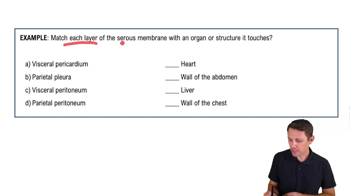
Organization of the Body: Serous Membrane Locations Example 1

Specific Functions of Muscle Tissue

The functions of muscle tissues vary: skeletal muscle enables voluntary body movements and posture, cardiac muscle contracts rhythmically to circulate blood, and smooth muscle controls involuntary movements such as constriction of blood vessels and movement of food through the digestive tract. These functions align with their structure and location.
Recommended video:
Guided course
4:36
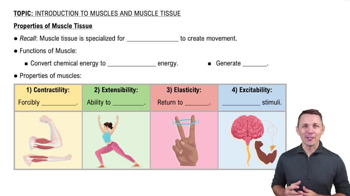
Properties of Muscle Tissue