Name and describe the four special functional abilities of muscle that are the basis for muscle response.
Ch. 9 Muscles and Muscle Tissue

Marieb, Hoehn11th EditionHuman Anatomy & PhysiologyISBN: 9780136874034Not the one you use?Change textbook
Chapter 9, Problem 14
The smooth muscle type found in the walls of digestive and urinary system organs and that exhibits gap junctions and pacemaker cells is:
a. Multi unit
b. Unitary
Verified step by step guidance1
Step 1: Understand the two types of smooth muscle: multi-unit and unitary (also called visceral). Multi-unit smooth muscle consists of individual fibers that operate independently, while unitary smooth muscle fibers are connected and function as a single unit.
Step 2: Recall that unitary smooth muscle is characterized by the presence of gap junctions, which allow electrical signals to pass directly between cells, enabling coordinated contractions.
Step 3: Recognize that unitary smooth muscle also contains pacemaker cells, which generate spontaneous action potentials to initiate rhythmic contractions without external stimuli.
Step 4: Note that unitary smooth muscle is typically found in the walls of hollow organs such as those in the digestive and urinary systems, where coordinated contractions are necessary for functions like peristalsis and urine flow.
Step 5: Conclude that the smooth muscle type described in the problem—found in digestive and urinary system walls, exhibiting gap junctions and pacemaker cells—is unitary smooth muscle.

Verified video answer for a similar problem:
This video solution was recommended by our tutors as helpful for the problem above.
Video duration:
3mWas this helpful?
Key Concepts
Here are the essential concepts you must grasp in order to answer the question correctly.
Smooth Muscle Types
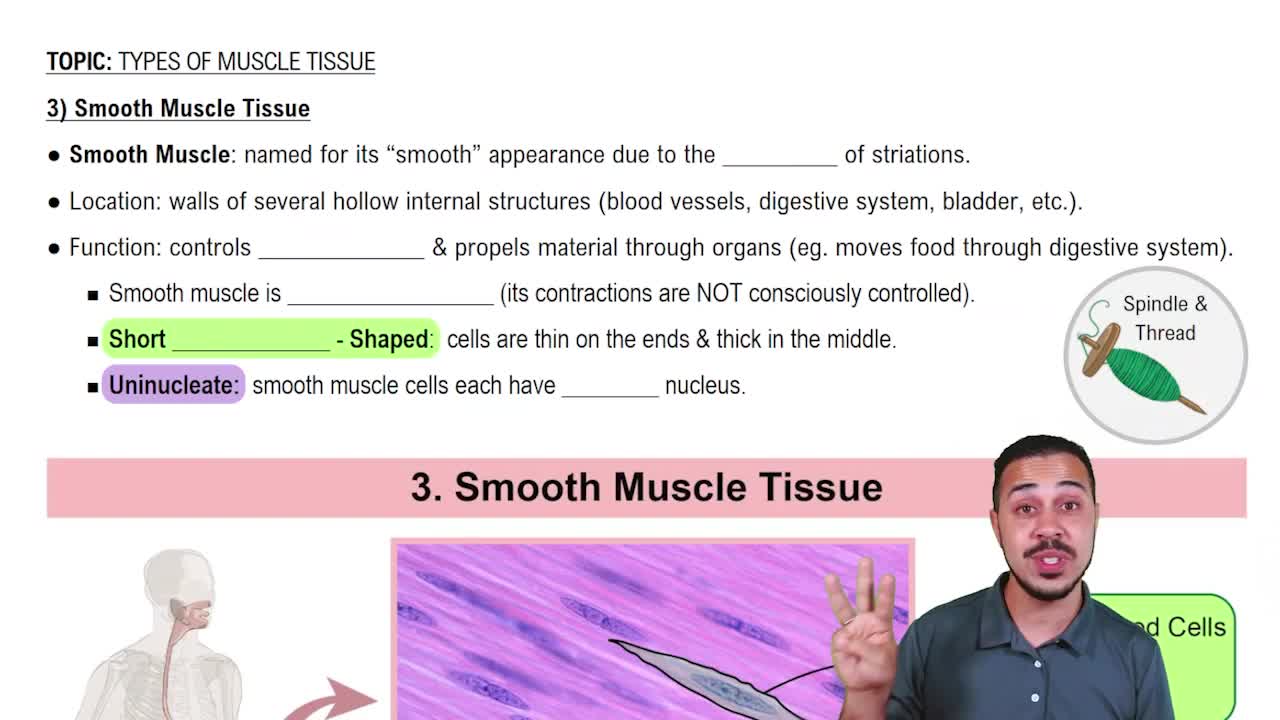
Smooth muscle is classified into two main types: multi-unit and unitary (single-unit). Multi-unit smooth muscle consists of individual fibers that contract independently, while unitary smooth muscle fibers are connected and contract as a single unit, commonly found in the walls of hollow organs.
Recommended video:
Guided course
Smooth Muscle Tissue
Gap Junctions in Smooth Muscle
Gap junctions are specialized connections between smooth muscle cells that allow direct electrical communication. These junctions enable coordinated contraction by allowing ions and small molecules to pass between cells, which is characteristic of unitary smooth muscle.
Recommended video:
Guided course
Smooth Muscle Tissue
Pacemaker Cells in Smooth Muscle
Pacemaker cells are specialized smooth muscle cells that generate spontaneous electrical impulses, initiating rhythmic contractions. These cells are typical in unitary smooth muscle, such as in the digestive and urinary systems, facilitating coordinated and automatic muscle activity.
Recommended video:
Guided course
Smooth Muscle Tissue
Related Practice
Textbook Question
1173
views
3
rank
Textbook Question
Distinguish between
a. Direct and indirect muscle attachments and
b. A tendon and an aponeurosis
1916
views
1
rank
Textbook Question
Aerobic exercise results in all of the following except:
a. More capillaries surrounding muscle fibers
b. More mitochondria in muscle cells
c. Increased size and strength of existing muscle cells
d. More myoglobin
1448
views
1
rank
Textbook Question
Myoglobin has a special function in muscle tissue. It:
a. Breaks down glycogen
b. Is a contractile protein
c. Holds a reserve supply of oxygen in the muscle
1093
views
1
rank
Textbook Question
The ions that enter the skeletal muscle cell during the generation of an action potential are
a. Calcium ions
b. Chloride ions
c. Sodium ions
d. Potassium ions
1194
views
1
rank
Textbook Question
What is the importance of acetylcholinesterase in muscle cell contraction?
1161
views
1
rank