Ch. 1 The Human Body: An Orientation
Marieb - Essentials of Human Anatomy & Physiology 13th Edition
Marieb13th EditionEssentials of Human Anatomy & PhysiologyISBN: 9780135624340Not the one you use?Change textbook
Chapter 1, Problem 12

Which of the following organ systems—digestive, respiratory, reproductive, circulatory, urinary, or muscular—are found in both subdivisions of the ventral body cavity?
Which are found in the thoracic cavity only?
In the abdominopelvic cavity only?

Verified step by step guidance
1
Step 1: Begin by understanding the ventral body cavity, which is divided into two main subdivisions: the thoracic cavity and the abdominopelvic cavity. The thoracic cavity is located above the diaphragm and contains organs such as the lungs and heart, while the abdominopelvic cavity is located below the diaphragm and contains organs such as the stomach, intestines, and reproductive organs.
Step 2: Identify the organ systems listed in the problem: digestive, respiratory, reproductive, circulatory, urinary, and muscular. Determine which organs from these systems are present in the thoracic cavity, abdominopelvic cavity, or both.
Step 3: For the thoracic cavity, focus on systems that include organs such as the lungs (respiratory system) and heart (circulatory system). These systems are primarily found in the thoracic cavity.
Step 4: For the abdominopelvic cavity, focus on systems that include organs such as the stomach and intestines (digestive system), kidneys and bladder (urinary system), and reproductive organs (reproductive system). These systems are primarily found in the abdominopelvic cavity.
Step 5: Consider the muscular system, which is found throughout the body and therefore spans both the thoracic and abdominopelvic cavities. Summarize which systems are exclusive to each cavity and which are found in both subdivisions of the ventral body cavity.

Verified video answer for a similar problem:

This video solution was recommended by our tutors as helpful for the problem above.
Video duration:
2m
Was this helpful?

Key Concepts

Here are the essential concepts you must grasp in order to answer the question correctly.

Ventral Body Cavity

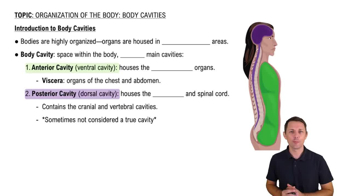
The ventral body cavity is a large internal space in the body that houses several organ systems. It is divided into two main subdivisions: the thoracic cavity, which contains the heart and lungs, and the abdominopelvic cavity, which includes the digestive, urinary, and reproductive organs. Understanding this division is crucial for identifying which organ systems are located in each subdivision.
Recommended video:
Guided course
3:20
Introduction to Body Cavities

Thoracic Cavity

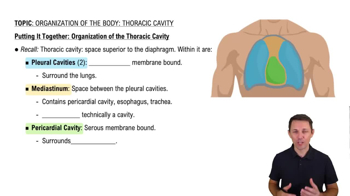
The thoracic cavity is the upper subdivision of the ventral body cavity, located above the diaphragm. It contains vital organs such as the heart, lungs, and major blood vessels. Recognizing the specific organ systems found in this cavity is essential for answering questions about their location and function within the body.
Recommended video:
Guided course
2:51
Organization of the Thoracic Cavity

Abdominopelvic Cavity

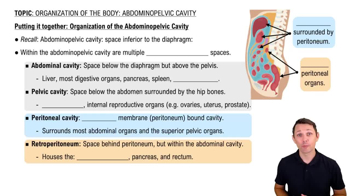
The abdominopelvic cavity is the lower subdivision of the ventral body cavity, situated below the diaphragm. It encompasses the abdominal cavity, which houses organs like the stomach and intestines, and the pelvic cavity, which contains the bladder and reproductive organs. Identifying the organ systems exclusive to this cavity is important for understanding their roles in bodily functions.
Recommended video:
Guided course
5:46
Organization of the Abdominopelvic Cavity