Lymphocytes continuously circulate through the body using blood and lymph as their transport vehicles. What is the importance of this recirculation behavior?
Ch. 10 Blood

Marieb13th EditionEssentials of Human Anatomy & PhysiologyISBN: 9780135624340Not the one you use?Change textbook
Chapter 10, Problem 21
If you had a high hematocrit, would you expect your hemoglobin determination to be high or low? Why?
Verified step by step guidance1
Understand the relationship between hematocrit and hemoglobin: Hematocrit is the percentage of red blood cells (RBCs) in the blood, while hemoglobin is the protein within RBCs responsible for oxygen transport. Generally, a higher hematocrit indicates a higher concentration of RBCs, which often correlates with higher hemoglobin levels.
Consider the physiological basis: Hemoglobin is contained within RBCs, so if the hematocrit is high (more RBCs in the blood), it is reasonable to expect that the hemoglobin concentration would also be elevated, assuming normal RBC function and no underlying pathology.
Account for potential exceptions: High hematocrit does not always guarantee high hemoglobin. For example, in conditions like polycythemia vera, both hematocrit and hemoglobin are elevated, but in cases of dehydration, hematocrit may appear high due to reduced plasma volume without a proportional increase in hemoglobin.
Evaluate the cause of high hematocrit: Determine whether the high hematocrit is due to increased RBC production (e.g., erythropoiesis stimulated by hypoxia) or other factors like dehydration. This context helps confirm whether hemoglobin levels are likely to be high.
Conclude based on the relationship: If the high hematocrit is due to increased RBC production and normal RBC function, hemoglobin determination would likely be high. However, if the high hematocrit is due to plasma volume reduction (e.g., dehydration), hemoglobin levels may not be proportionally elevated.

Verified video answer for a similar problem:
This video solution was recommended by our tutors as helpful for the problem above.
Video duration:
1mWas this helpful?
Key Concepts
Here are the essential concepts you must grasp in order to answer the question correctly.
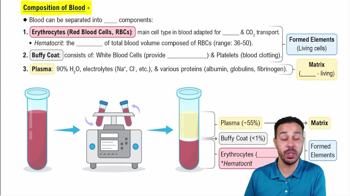
Hematocrit
Hematocrit is the proportion of blood volume that is occupied by red blood cells (RBCs). It is expressed as a percentage and is a key indicator of blood's oxygen-carrying capacity. A high hematocrit suggests a higher concentration of RBCs, which can occur in conditions like dehydration or polycythemia.
Recommended video:
Composition of Blood
Hemoglobin
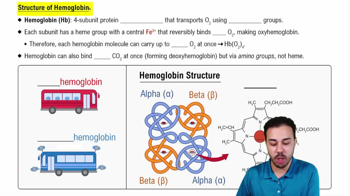
Hemoglobin is a protein found in red blood cells responsible for transporting oxygen from the lungs to the body's tissues and returning carbon dioxide from the tissues back to the lungs. The hemoglobin level is often measured alongside hematocrit to assess overall blood health and oxygen delivery capacity. Typically, hemoglobin levels correlate with hematocrit values.
Recommended video:
Structure of Hemoglobin
Relationship between Hematocrit and Hemoglobin
There is a direct relationship between hematocrit and hemoglobin levels; as hematocrit increases, hemoglobin levels usually increase as well. This is because a higher proportion of RBCs in the blood generally means more hemoglobin is present, enhancing the blood's ability to carry oxygen. Therefore, if hematocrit is high, one would expect hemoglobin levels to also be high.
Recommended video:
Structure of Hemoglobin
Related Practice
Textbook Question
876
views
Textbook Question
Name the formed elements that arise from myeloid stem cells. Name those arising from lymphoid stem cells.
1594
views
Textbook Question
Define anemia, and give three possible causes.
967
views
Textbook Question
A woman comes to the clinic complaining of fatigue, shortness of breath, and chills. Blood tests show anemia, and a bleeding ulcer is diagnosed. What type of anemia is this?
665
views
Textbook Question
How can liver dysfunction cause bleeding disorders?
1024
views
Textbook Question
A bone marrow biopsy of Mr. Lee, a man on long-term drug therapy, shows an abnormally high percentage of nonhematopoietic connective tissue. What condition does this indicate? If the symptoms are critical, what short-term and long-term treatments are indicated? Which treatment is he more likely to be given: infusion of whole blood or of packed red cells?
1196
views