Ch. 11 Cardiovascular System
Marieb - Essentials of Human Anatomy & Physiology 13th Edition
Marieb13th EditionEssentials of Human Anatomy & PhysiologyISBN: 9780135624340Not the one you use?Change textbook
Chapter 11, Problem 22

How does the heart's ability to contract differ from that of other muscles of the body?

Verified step by step guidance
1
Understand the unique properties of cardiac muscle: Cardiac muscle is specialized for continuous, rhythmic contraction. Unlike skeletal muscle, which requires neural stimulation to contract, cardiac muscle has intrinsic contractility due to the presence of pacemaker cells in the sinoatrial (SA) node.
Learn about the role of pacemaker cells: The SA node generates electrical impulses automatically, without external stimulation. These impulses spread through the heart, causing coordinated contraction. This property is called autorhythmicity, which is unique to cardiac muscle.
Compare cardiac muscle to skeletal muscle: Skeletal muscle contraction is voluntary and requires signals from the nervous system. In contrast, cardiac muscle contraction is involuntary and self-regulated, though it can be influenced by the autonomic nervous system to adjust heart rate and force of contraction.
Explore the role of intercalated discs: Cardiac muscle cells are connected by intercalated discs, which contain gap junctions and desmosomes. Gap junctions allow electrical impulses to pass quickly between cells, ensuring synchronized contraction, while desmosomes provide structural support during contraction.
Understand the importance of calcium in cardiac contraction: Calcium plays a critical role in cardiac muscle contraction. The influx of calcium ions during an action potential triggers the release of more calcium from the sarcoplasmic reticulum, leading to contraction. This process is known as calcium-induced calcium release, which is distinct from the mechanism in skeletal muscle.

Verified video answer for a similar problem:

This video solution was recommended by our tutors as helpful for the problem above.
Video duration:
2m
Was this helpful?

Key Concepts

Here are the essential concepts you must grasp in order to answer the question correctly.

Cardiac Muscle Physiology

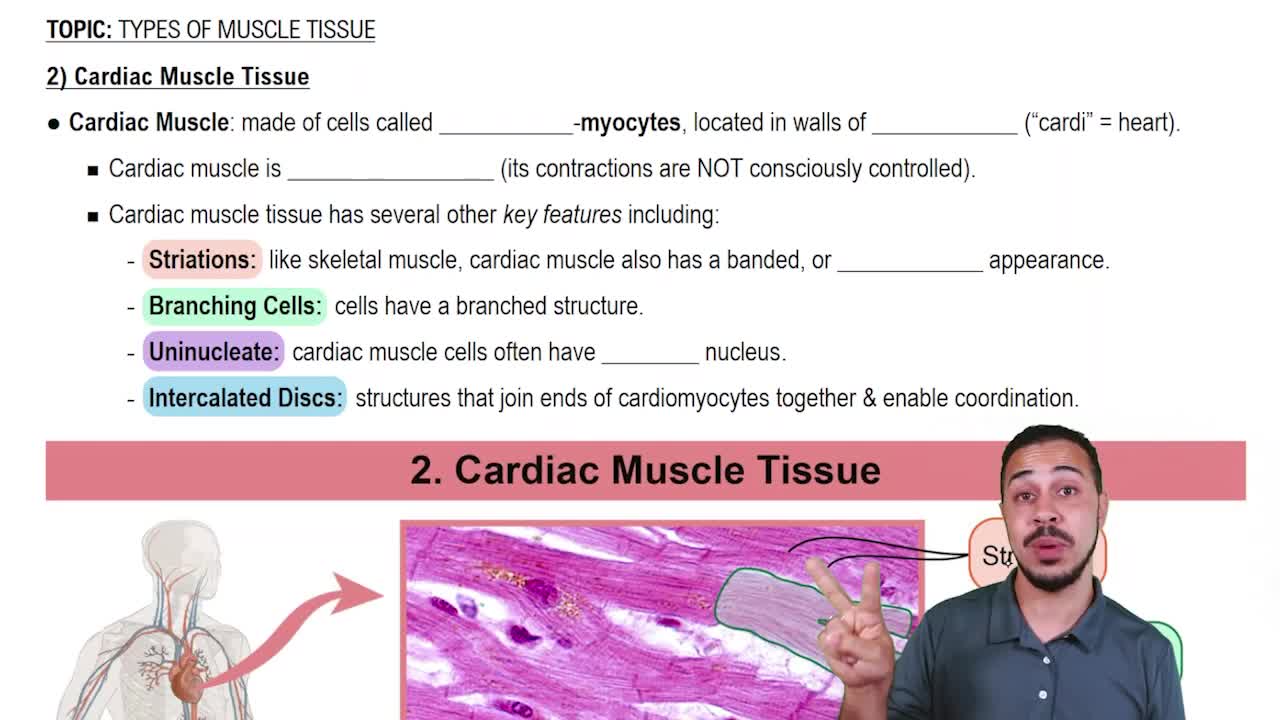
Cardiac muscle is unique in its structure and function, characterized by intercalated discs that allow for synchronized contractions. Unlike skeletal muscle, which is under voluntary control, cardiac muscle operates involuntarily and is influenced by the autonomic nervous system and hormones. This specialization enables the heart to pump blood efficiently and rhythmically.
Recommended video:
Guided course
06:00
Cardiac Muscle Tissue

Excitation-Contraction Coupling

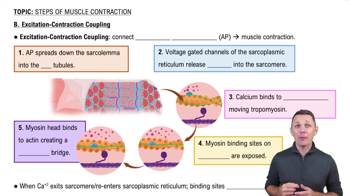
Excitation-contraction coupling refers to the physiological process by which an electrical stimulus leads to muscle contraction. In cardiac muscle, this process involves the influx of calcium ions through voltage-gated channels, triggering further calcium release from the sarcoplasmic reticulum. This mechanism is crucial for the heart's ability to contract and relax in a coordinated manner.
Recommended video:
Guided course
5:47
B. Excitation-Contraction Coupling

Pacemaker Cells

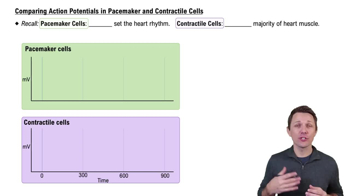
Pacemaker cells, primarily located in the sinoatrial (SA) node of the heart, are specialized cardiac cells that generate electrical impulses autonomously. These impulses initiate the contraction of the heart muscle, setting the rhythm for the heartbeat. This intrinsic ability distinguishes cardiac muscle from skeletal muscle, which requires neural stimulation for contraction.
Recommended video:
Guided course
6:36
Comparing Action Potentials in Pacemaker and Contractile Cells