Ch. 11 Cardiovascular System
Marieb - Essentials of Human Anatomy & Physiology 13th Edition
Marieb13th EditionEssentials of Human Anatomy & PhysiologyISBN: 9780135624340Not the one you use?Change textbook
Chapter 11, Problem 3

More than one choice may apply.
Which of the following depolarizes next after the AV node?

Verified step by step guidance
1
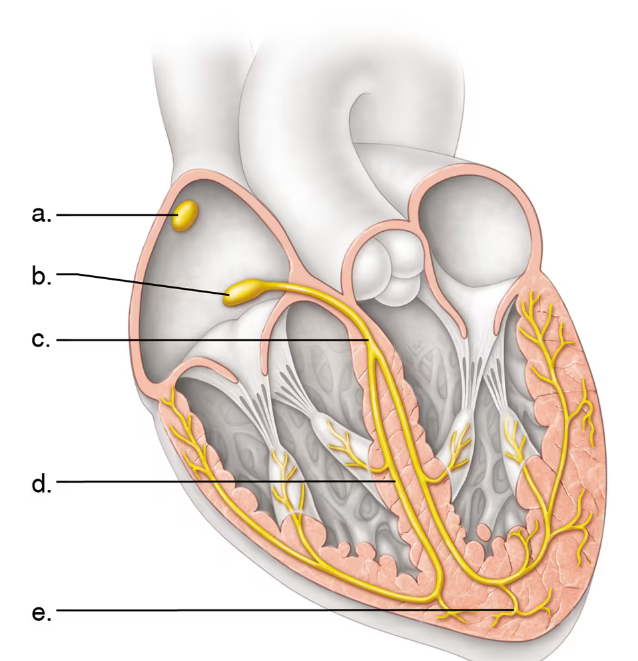
Step 1: Identify the labeled parts in the heart conduction system image. Label 'a' is the sinoatrial (SA) node, 'b' is the atrioventricular (AV) node, 'c' is the atrioventricular (AV) bundle (bundle of His), 'd' is the right bundle branch, and 'e' is the Purkinje fibers.
Step 2: Understand the sequence of depolarization in the heart's conduction system. The SA node initiates the heartbeat by depolarizing first, followed by the AV node.
Step 3: After the AV node depolarizes, the electrical impulse travels to the AV bundle (bundle of His), which is labeled 'c' in the image.
Step 4: From the AV bundle, the impulse then travels down the right and left bundle branches (label 'd' for the right bundle branch) to the Purkinje fibers (label 'e').
Step 5: Therefore, the structures that depolarize next after the AV node are the AV bundle (c), the bundle branches (d), and the Purkinje fibers (e).

Verified video answer for a similar problem:

This video solution was recommended by our tutors as helpful for the problem above.
Video duration:
3m
Was this helpful?

Key Concepts

Here are the essential concepts you must grasp in order to answer the question correctly.

Cardiac Conduction System

The cardiac conduction system is a network of specialized muscle cells responsible for generating and transmitting electrical impulses that coordinate heartbeats. It includes the sinoatrial (SA) node, atrioventricular (AV) node, bundle of His, bundle branches, and Purkinje fibers. This system ensures the heart contracts in a synchronized manner to efficiently pump blood.
Recommended video:
Guided course
7:10
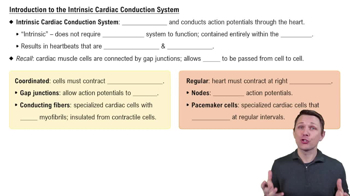
Intrinsic Cardiac Conduction System

Sequence of Depolarization in the Heart

Depolarization in the heart follows a specific sequence starting at the SA node, then the AV node, followed by the bundle of His, bundle branches, and finally the Purkinje fibers. After the AV node depolarizes, the electrical impulse travels to the bundle of His and then to the bundle branches, which conduct the impulse to the ventricles, causing them to contract.
Recommended video:
Guided course
6:13
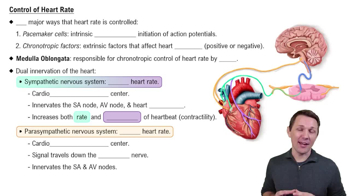
Control of Heart Rate

Role of the AV Node in Cardiac Rhythm

The AV node acts as a critical electrical relay station between the atria and ventricles, delaying the impulse to allow atrial contraction before ventricular contraction. It controls the timing of ventricular depolarization and ensures the heart beats in a coordinated rhythm. After the AV node, the impulse moves to the bundle of His and its branches.
Recommended video:
Guided course
3:41
Cardiac Cycle Example 2