Ch. 15 The Urinary System
Marieb - Essentials of Human Anatomy & Physiology 13th Edition
Marieb13th EditionEssentials of Human Anatomy & PhysiologyISBN: 9780135624340Not the one you use?Change textbook
Chapter 15, Problem 26

What happens to the rate of RBC production in a patient on dialysis with total renal failure? What could be given to the patient to counteract such a problem?

Verified step by step guidance
1
Understand the role of the kidneys in red blood cell (RBC) production: The kidneys produce erythropoietin, a hormone that stimulates the bone marrow to produce RBCs. In total renal failure, the kidneys lose their ability to produce erythropoietin, leading to decreased RBC production and anemia.
Recognize the impact of dialysis: Dialysis replaces the filtration function of the kidneys but does not restore their ability to produce erythropoietin. Therefore, patients on dialysis with total renal failure often experience chronic anemia due to insufficient erythropoietin production.
Identify the treatment for anemia caused by renal failure: To counteract the lack of erythropoietin, synthetic erythropoietin (e.g., erythropoiesis-stimulating agents like epoetin alfa) can be administered to stimulate RBC production in the bone marrow.
Consider additional supportive measures: Patients may also require iron supplementation, as iron is a critical component of hemoglobin in RBCs. Iron deficiency can further impair RBC production, so ensuring adequate iron levels is essential.
Review Table 9.2 for further details: Table 9.2 likely provides information on erythropoiesis-stimulating agents, their mechanism of action, and their role in managing anemia in patients with renal failure. Use this table to deepen your understanding of the treatment options.

Verified video answer for a similar problem:

This video solution was recommended by our tutors as helpful for the problem above.
Video duration:
3m
Was this helpful?

Key Concepts

Here are the essential concepts you must grasp in order to answer the question correctly.

Renal Failure and Erythropoiesis

Renal failure significantly impacts erythropoiesis, the process of red blood cell (RBC) production. The kidneys produce erythropoietin (EPO), a hormone that stimulates RBC production in the bone marrow. In total renal failure, EPO production is severely diminished, leading to decreased RBC production and potentially resulting in anemia.
Recommended video:
4:58
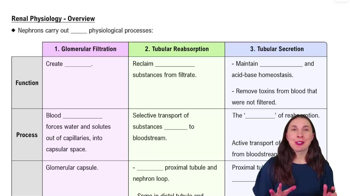
Overview of Renal Physiology

Dialysis and Its Effects

Dialysis is a medical treatment that performs the functions of the kidneys, including the removal of waste products and excess fluids from the blood. However, it does not replace the hormonal functions of the kidneys, such as EPO production. As a result, patients on dialysis often experience anemia due to the lack of adequate RBC production.
Recommended video:
1:32
Effects of the Complement System

Erythropoietin Therapy

Erythropoietin therapy involves administering synthetic EPO to patients with anemia, particularly those with chronic kidney disease or on dialysis. This treatment stimulates the bone marrow to increase RBC production, helping to counteract anemia and improve the patient's overall health and energy levels.
Recommended video:
07:43
CRISPR CAS