Ch. 2 Basic Chemistry
Marieb - Essentials of Human Anatomy & Physiology 13th Edition
Marieb13th EditionEssentials of Human Anatomy & PhysiologyISBN: 9780135624340Not the one you use?Change textbook
Chapter 2, Problem 19

Identify each of the following reactions as a synthesis, decomposition, or exchange reaction:
2Hg + O₂ 2HgO
Fe²¹ + CuSO₄ → FeSO₄ + Cu²¹
HCl + NaOH → NaCl + H₂O
HNO₃ → H⁺ + NO₃⁻

Verified step by step guidance
1
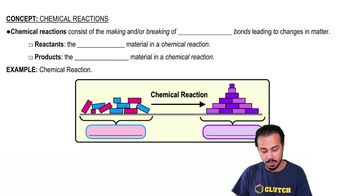
Step 1: Understand the three types of chemical reactions. Synthesis reactions involve combining two or more reactants to form a single product. Decomposition reactions involve breaking down a compound into simpler substances. Exchange reactions involve swapping components between reactants to form new products.
Step 2: Analyze the first reaction: 2Hg + O₂ → 2HgO. Here, two reactants (Hg and O₂) combine to form a single product (HgO). This is characteristic of a synthesis reaction.
Step 3: Analyze the second reaction: Fe²¹ + CuSO₄ → FeSO₄ + Cu²¹. In this reaction, components are exchanged between the reactants (Fe²¹ and CuSO₄), resulting in new products (FeSO₄ and Cu²¹). This is an exchange reaction.
Step 4: Analyze the third reaction: HCl + NaOH → NaCl + H₂O. This reaction involves the exchange of ions between HCl and NaOH to form NaCl and H₂O. This is also an exchange reaction, specifically a neutralization reaction.
Step 5: Analyze the fourth reaction: HNO₃ → H⁺ + NO₃⁻. Here, a single compound (HNO₃) breaks down into two simpler substances (H⁺ and NO₃⁻). This is characteristic of a decomposition reaction.

Verified video answer for a similar problem:

This video solution was recommended by our tutors as helpful for the problem above.
Video duration:
2m
Was this helpful?

Key Concepts

Here are the essential concepts you must grasp in order to answer the question correctly.

Synthesis Reaction

A synthesis reaction, also known as a combination reaction, occurs when two or more reactants combine to form a single product. This type of reaction can be represented by the general equation A + B → AB. An example is the reaction of mercury and oxygen to form mercury oxide (2Hg + O₂ → 2HgO).
Recommended video:
01:56
Chemical Reactions

Decomposition Reaction

A decomposition reaction involves the breakdown of a single compound into two or more simpler products. This can be represented by the general equation AB → A + B. An example is the dissociation of nitric acid into hydrogen ions and nitrate ions (HNO₃ → H⁺ + NO₃⁻).
Recommended video:
01:56
Chemical Reactions

Exchange Reaction

An exchange reaction, also known as a double displacement reaction, occurs when parts of two compounds exchange places to form two new compounds. This can be represented by the general equation AB + CD → AD + CB. An example is the reaction between iron ions and copper sulfate, resulting in iron sulfate and copper (Fe²¹ + CuSO₄ → FeSO₄ + Cu²¹).
Recommended video:
01:56
Chemical Reactions