Define radioactivity. If an element has three isotopes, which of them (the lightest, the one with an intermediate mass, or the heaviest) is most likely to be a radioisotope, and why?
Ch. 2 Basic Chemistry

Marieb13th EditionEssentials of Human Anatomy & PhysiologyISBN: 9780135624340Not the one you use?Change textbook
Chapter 2, Problem 13
Name and provide the atomic symbols of the four elements that make up the bulk of all living matter. Which of these is found primarily in proteins and nucleic acids?
Verified step by step guidance1
Identify the four elements that make up the bulk of all living matter. These are carbon (C), hydrogen (H), oxygen (O), and nitrogen (N).
Understand the role of each element: Carbon is the backbone of organic molecules, hydrogen is involved in energy transfer and pH balance, oxygen is essential for cellular respiration, and nitrogen is a key component of amino acids and nucleotides.
Recognize that nitrogen is the element found primarily in proteins and nucleic acids. Proteins are made of amino acids, which contain nitrogen in their amino groups (-NH2). Nucleic acids (DNA and RNA) contain nitrogen in their nitrogenous bases (adenine, guanine, cytosine, thymine, and uracil).
Learn the significance of nitrogen in biological molecules: Nitrogen is crucial for the structure and function of proteins and nucleic acids, which are essential for cellular processes such as enzyme activity and genetic information storage.
Review the atomic symbols: Carbon (C), hydrogen (H), oxygen (O), and nitrogen (N) are the four elements, with nitrogen being the one primarily associated with proteins and nucleic acids.

Verified video answer for a similar problem:
This video solution was recommended by our tutors as helpful for the problem above.
Video duration:
1mWas this helpful?
Key Concepts
Here are the essential concepts you must grasp in order to answer the question correctly.
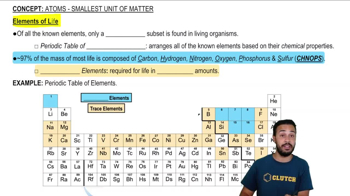
Elements of Life
The four elements that make up the bulk of all living matter are carbon (C), hydrogen (H), oxygen (O), and nitrogen (N). These elements are fundamental to the structure and function of biological molecules, forming the backbone of organic compounds essential for life.
Recommended video:
Elements of Life
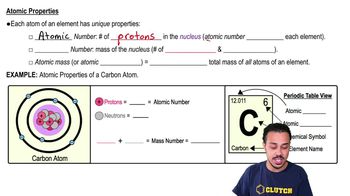
Atomic Symbols
Atomic symbols are one- or two-letter abbreviations used to represent chemical elements on the periodic table. For example, carbon is represented by 'C', hydrogen by 'H', oxygen by 'O', and nitrogen by 'N'. These symbols are universally recognized in scientific communication.
Recommended video:
Atomic Properties
Proteins and Nucleic Acids
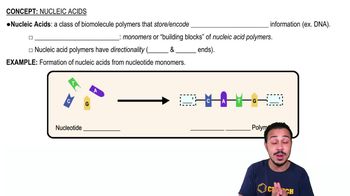
Proteins and nucleic acids (DNA and RNA) are crucial macromolecules in living organisms. Nitrogen is primarily found in proteins and nucleic acids, as it is a key component of amino acids (the building blocks of proteins) and nucleotides (the building blocks of nucleic acids).
Recommended video:
Nucleic Acids
Related Practice
Textbook Question
56
views
Textbook Question
Factors that increase the speed of chemical reactions include:
a. Increasing the temperature
b. Increasing the particle size
c. Increasing the concentration of the reactants
d. Catalysts
45
views
Textbook Question
Matter occupies space and has mass. Explain how energy must be described in terms of these two factors. Then define energy.
54
views
Textbook Question
Which of the following forms the basic structure of cell membranes?
Which is the basis for producing sex hormones?
42
views
Textbook Question
Describe how the two 'generic' atoms shown below would form an ionic bond. Include in your answer where electrons come from, where they go, and why.
59
views
Textbook Question
Define molecule as it relates to molecular substances and compounds.
40
views