Ch. 4 Skin and Body Membranes
Marieb - Essentials of Human Anatomy & Physiology 13th Edition
Marieb13th EditionEssentials of Human Anatomy & PhysiologyISBN: 9780135624340Not the one you use?Change textbook
Chapter 4, Problem 15

Name three changes that occur in the skin as one ages.

Verified step by step guidance
1
Understand that aging affects the skin due to intrinsic factors (natural aging) and extrinsic factors (environmental exposure, such as UV radiation). These changes impact the structure and function of the skin.
Identify the first change: The epidermis (outer layer of the skin) becomes thinner over time, leading to a decrease in the skin's ability to protect against external damage and slower wound healing.
Recognize the second change: Collagen and elastin fibers in the dermis (middle layer of the skin) degrade, resulting in reduced elasticity and the formation of wrinkles.
Note the third change: Sebaceous glands produce less oil, leading to dryness and a decrease in the skin's ability to retain moisture.
Consider additional factors such as reduced melanocyte activity, which can cause uneven pigmentation or age spots, and discuss how these changes collectively impact the skin's appearance and function.

Verified video answer for a similar problem:

This video solution was recommended by our tutors as helpful for the problem above.
Video duration:
2m
Was this helpful?

Key Concepts

Here are the essential concepts you must grasp in order to answer the question correctly.

Decreased Collagen Production

As individuals age, the skin's ability to produce collagen diminishes significantly. Collagen is a vital protein that provides structure and elasticity to the skin. This reduction leads to sagging, wrinkles, and a loss of firmness, making the skin appear older and less resilient.
Recommended video:
07:25
Total Products for Each Stage of Aerobic Cellular Respiration

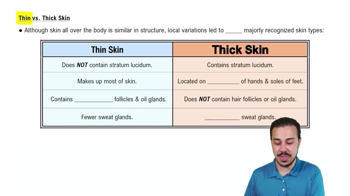
Thinning of the Epidermis

The epidermis, the outermost layer of the skin, becomes thinner with age. This thinning can result in increased fragility and susceptibility to injuries, as well as a decrease in the skin's ability to retain moisture. Consequently, older skin may appear more translucent and less vibrant.
Recommended video:
02:29
Thin vs. Thick Skin

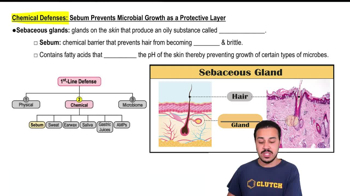
Decreased Sebum Production

Sebum is an oily substance produced by sebaceous glands that helps to keep the skin moisturized and protected. As people age, the production of sebum decreases, leading to drier skin. This lack of moisture can contribute to the appearance of fine lines and a rough texture, further emphasizing the signs of aging.
Recommended video:
1:56
Sebum
Related Practice
Textbook Question

Both newborn infants and aged individuals have very little subcutaneous tissue. How does this affect their sensitivity to cold environmental temperature?

34
views
Textbook Question

Match the appropriate structure with the proper description and/or function.

1. Made of dense, irregular connective tissue

 2. Produce sebum

3. Helps regulate body temperature by producing sweat

4. Cause fingerprints

5. Houses the hair root

6. Superficial keratinized stratified squamous epithelium

7. Deep pressure receptors

8. Vascular layer that houses skin appendages

a. Dermal papillae

b. Lamellar corpuscles

c. Dermis

d. Hair follicle

e. Epidermis

f. Eccrine sweat gland

g. Reticular layer

h. Sebaceous glands

39
views
Textbook Question

Roger, a 40-year-old man who loves spending time on the beach, is complaining to you that his suntan made him popular when he was young—but now his face is all wrinkled, and he has several darkly pigmented moles that are growing rapidly and are as big as large coins. He shows you the moles, and immediately you think “ABCDE.” What does that mean, and why should he be concerned?

34
views
Textbook Question

Match the appropriate structure with the proper description and/or function.

1. Made of dense, irregular connective tissue

 2. Produce sebum

3. Helps regulate body temperature by producing sweat

4. Cause fingerprints

5. Houses the hair root

6. Superficial keratinized stratified squamous epithelium

7. Deep pressure receptors

8. Vascular layer that houses skin appendages

a. Dermal papillae

b. Lamellar corpuscles

c. Dermis

d. Hair follicle

e. Epidermis

f. Eccrine sweat gland

g. Reticular layer

h. Sebaceous glands

35
views
Textbook Question

From what types of damage does the skin protect the body?

970
views
Textbook Question

More than one choice may apply.

Which layer of the heart wall is an endothelium?

a. Endocardium

b. Myocardium

c. Epicardium

d. Pericardium

567
views