Ch. 6 The Muscular System
Marieb - Essentials of Human Anatomy & Physiology 13th Edition
Marieb13th EditionEssentials of Human Anatomy & PhysiologyISBN: 9780135624340Not the one you use?Change textbook
Chapter 6, Problem 19

Tell where each of the three types of muscle tissue would be found in the body. What is meant by the statement, 'Smooth muscles are involuntary in action'?

Verified step by step guidance
1
Step 1: Identify the three types of muscle tissue in the body: skeletal muscle, cardiac muscle, and smooth muscle. Each type has distinct characteristics and locations.
Step 2: Explain where skeletal muscle is found. Skeletal muscles are attached to bones and are responsible for voluntary movements, such as walking or lifting objects.
Step 3: Describe the location of cardiac muscle. Cardiac muscle is found exclusively in the walls of the heart, where it contracts rhythmically to pump blood throughout the body.
Step 4: Discuss where smooth muscle is located. Smooth muscle is found in the walls of hollow organs, such as the stomach, intestines, blood vessels, and the bladder. It helps move substances through these organs by contracting and relaxing.
Step 5: Clarify the meaning of 'Smooth muscles are involuntary in action.' This statement refers to the fact that smooth muscle contractions are controlled automatically by the autonomic nervous system, without conscious effort or control by the individual.

Verified video answer for a similar problem:

This video solution was recommended by our tutors as helpful for the problem above.
Video duration:
2m
Was this helpful?

Key Concepts

Here are the essential concepts you must grasp in order to answer the question correctly.

Types of Muscle Tissue

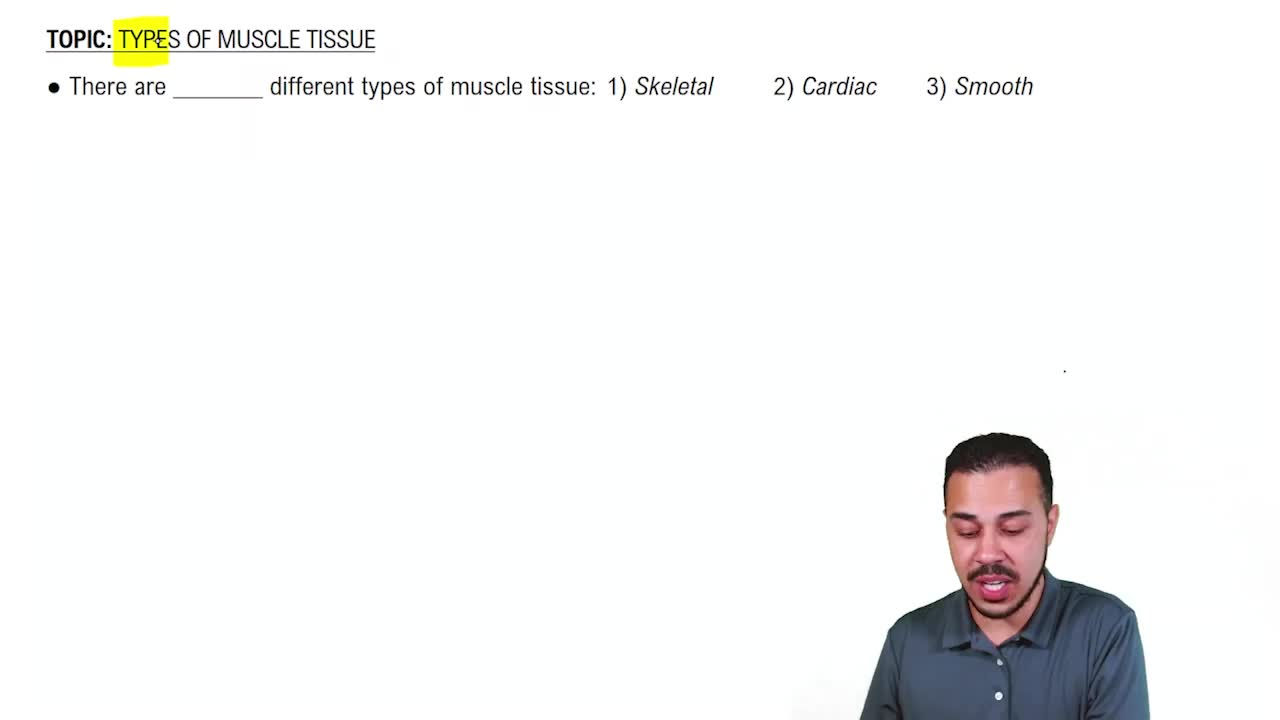
There are three types of muscle tissue in the human body: skeletal, cardiac, and smooth. Skeletal muscle is attached to bones and is responsible for voluntary movements. Cardiac muscle makes up the heart and is responsible for pumping blood, while smooth muscle is found in the walls of hollow organs, such as the intestines and blood vessels, facilitating involuntary movements.
Recommended video:
Guided course
00:36
3 Types of Muscle Tissue

Involuntary vs. Voluntary Muscle Control

Muscle control can be classified as voluntary or involuntary. Voluntary muscles, like skeletal muscles, are under conscious control, allowing for deliberate movements. In contrast, involuntary muscles, such as smooth and cardiac muscles, operate automatically without conscious thought, regulating essential functions like digestion and heartbeats.
Recommended video:
0:45
Control of the ANS Example 1

Function of Smooth Muscle

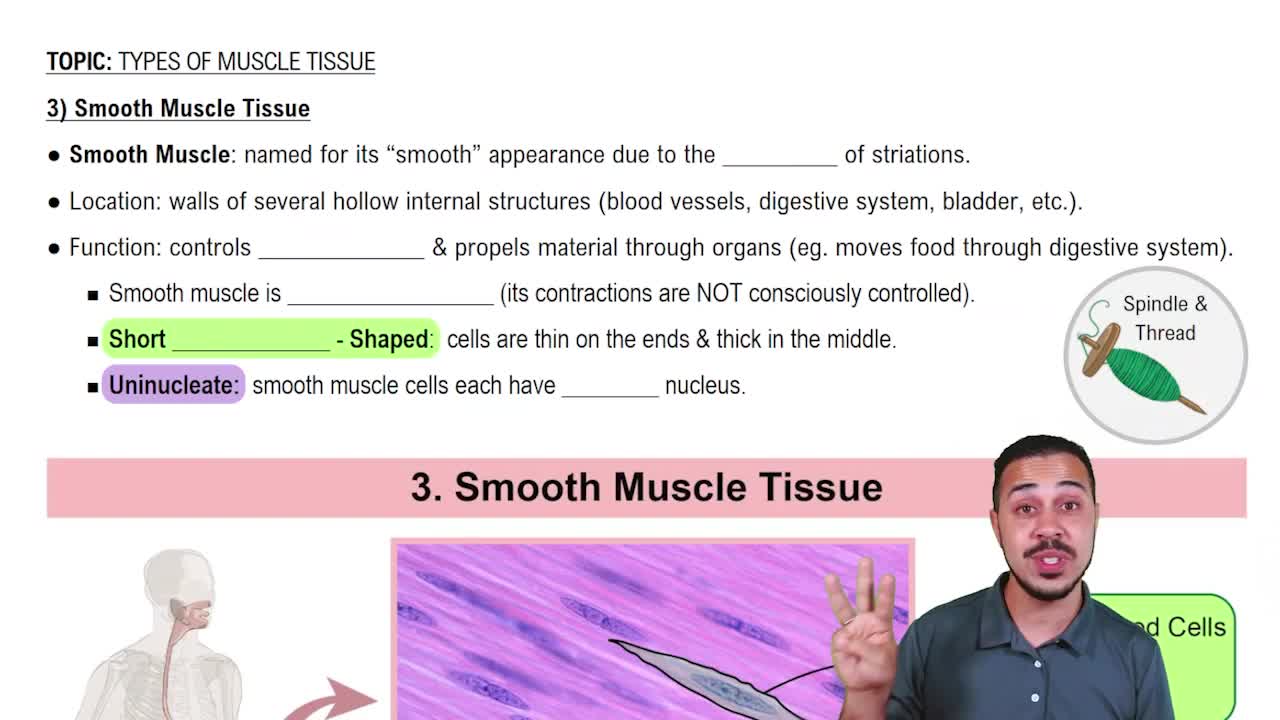
Smooth muscle tissue is primarily responsible for involuntary actions within the body. It is found in various organs, such as the stomach and blood vessels, where it helps regulate processes like peristalsis and blood flow. The term 'involuntary' indicates that these muscles contract and relax automatically, controlled by the autonomic nervous system rather than conscious effort.
Recommended video:
Guided course
06:27
Smooth Muscle Tissue
Related Practice
Textbook Question

When Eric returned from jogging, he was breathing heavily and sweating profusely, and he complained that his legs ached and felt weak. On the basis of what you have learned about muscle energy metabolism, respond to the following questions:

b. What ATP-harvesting pathway have his working muscles been using that leads to such a breathing pattern?

677
views
Textbook Question

Name three muscles or muscle groups used as sites for intramuscular injections. Which is most often used in babies?

1502
views
Textbook Question

Explain the general relationship between the muscles that flex and extend the wrist, including their location on the body.

1442
views
Textbook Question

When Eric returned from jogging, he was breathing heavily and sweating profusely, and he complained that his legs ached and felt weak. On the basis of what you have learned about muscle energy metabolism, respond to the following questions: c. What metabolic product(s) might account for his sore muscles and his feeling of muscle weakness?

653
views
Textbook Question

While jogging, Mr. Ahmadi was forced to jump out of the way of a speeding car. He heard a snapping sound that was immediately followed by pain in his right lower calf. A gap was visible between his swollen calf and his heel, and he was unable to plantar flex that foot. What do you think happened?

1209
views
Textbook Question

When Eric returned from jogging, he was breathing heavily and sweating profusely, and he complained that his legs ached and felt weak. On the basis of what you have learned about muscle energy metabolism, respond to the following questions:

a. Why is Eric breathing heavily?

668
views