Other than serving as a conduction pathway, what is a major function of the pons? Why is the medulla oblongata the most vital part of the brain?
Ch. 7 The Nervous System

Marieb13th EditionEssentials of Human Anatomy & PhysiologyISBN: 9780135624340Not the one you use?Change textbook
Chapter 7, Problem 16
Briefly explain how nerve impulses are initiated and transmitted, and why conduction at synapses is always one-way.
Verified step by step guidance1
Step 1: Nerve impulses are initiated when a stimulus causes the resting membrane potential of a neuron to reach the threshold level. This occurs due to the opening of voltage-gated sodium (Na⁺) channels, allowing Na⁺ ions to rush into the cell, depolarizing the membrane.
Step 2: Once the membrane is depolarized, the action potential propagates along the axon as voltage-gated sodium channels sequentially open, followed by the opening of voltage-gated potassium (K⁺) channels to repolarize the membrane. This creates a wave-like transmission of the impulse.
Step 3: At the axon terminal, the arrival of the action potential triggers the opening of voltage-gated calcium (Ca²⁺) channels. Calcium ions enter the terminal, causing synaptic vesicles to release neurotransmitters into the synaptic cleft via exocytosis.
Step 4: The neurotransmitters diffuse across the synaptic cleft and bind to specific receptors on the postsynaptic membrane. This binding initiates a response in the postsynaptic neuron, such as depolarization or hyperpolarization, depending on the type of neurotransmitter and receptor.
Step 5: Conduction at synapses is always one-way because neurotransmitters are released from the presynaptic neuron and receptors are located on the postsynaptic neuron. The structural and functional organization of synapses ensures that signals cannot travel backward.

Verified video answer for a similar problem:
This video solution was recommended by our tutors as helpful for the problem above.
Video duration:
3mWas this helpful?
Key Concepts
Here are the essential concepts you must grasp in order to answer the question correctly.
Nerve Impulse Initiation
Nerve impulses, or action potentials, are initiated when a neuron reaches a certain threshold of depolarization, typically due to the influx of sodium ions through voltage-gated ion channels. This rapid change in membrane potential propagates along the axon, allowing the signal to travel quickly over long distances. The all-or-nothing principle ensures that once the threshold is reached, the impulse will fully propagate without diminishing.
Recommended video:
Guided course
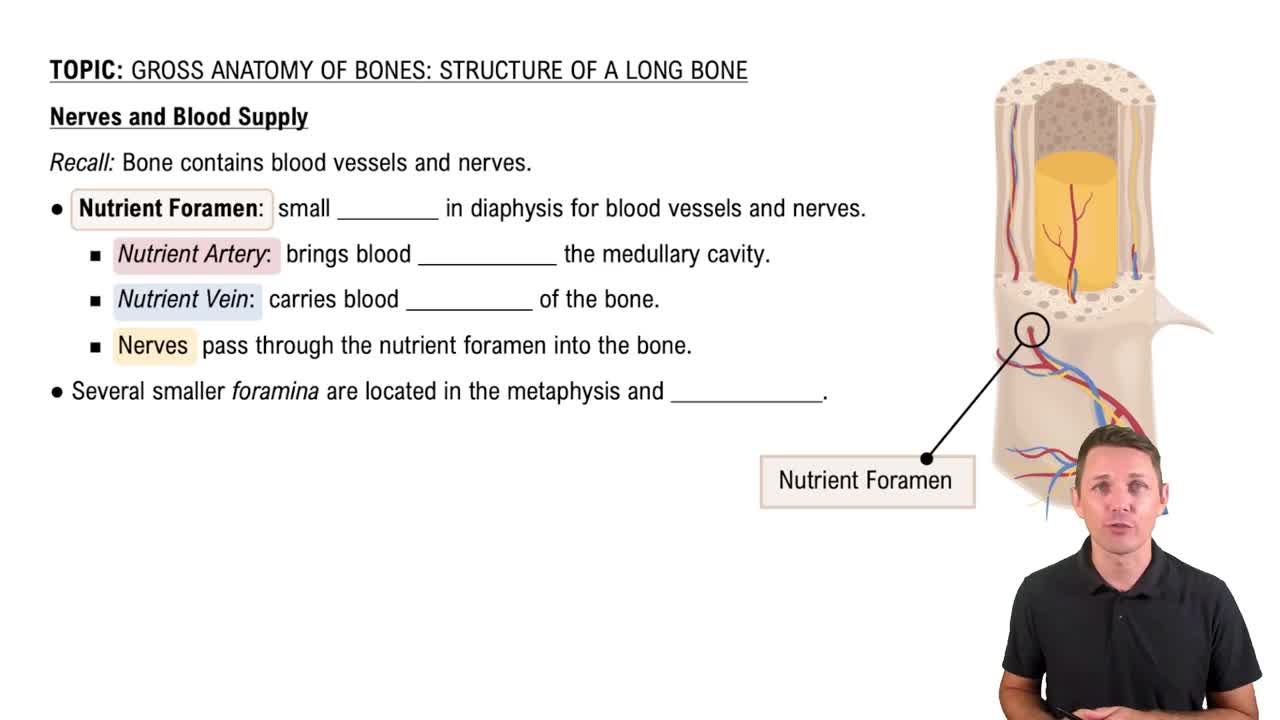
Nerves and Blood Supply
Transmission of Nerve Impulses
Transmission of nerve impulses occurs through a process called saltatory conduction in myelinated axons, where the impulse jumps between nodes of Ranvier, enhancing speed and efficiency. At the axon terminals, the arrival of the action potential triggers the release of neurotransmitters into the synaptic cleft, facilitating communication between neurons. This process is crucial for the rapid relay of information throughout the nervous system.
Recommended video:
Guided course
Nerves and Blood Supply
One-Way Conduction at Synapses
Conduction at synapses is always one-way due to the structural and functional organization of synaptic transmission. Neurotransmitters are released from the presynaptic neuron and bind to receptors on the postsynaptic neuron, initiating a response. The absence of receptors on the presynaptic side and the directional flow of neurotransmitter release ensure that signals travel in a single direction, preventing backward transmission and maintaining the integrity of neural communication.
Recommended video:
Guided course
Conduction Pathway and Contraction
Related Practice
Textbook Question
715
views
Textbook Question
What is the basis for the functional classification of neurons?
1198
views
Textbook Question
How many pairs of cranial nerves are there? Which are purely sensory? Which activates the chewing muscles? Which helps regulate heart rate and activity of the digestive tract?
776
views
Textbook Question
What region of the body is served by the dorsal rami of the spinal nerves? By the ventral rami?
1146
views
Textbook Question
Explain both the structural and functional classifications of the nervous system. In your explanation, include the subdivisions of each.
871
views
Textbook Question
Two major cell groups make up the nervous system—neurons and supporting cells such as astrocytes and Schwann cells. Which are 'nervous' cells?
Why? What are the major functions of the other cell group?
949
views