
Textbook Question
The chewing muscles that protract the mandible and produce side-to-side grinding movements are the
a. Buccinators
b. Masseters
c. Temporalis
d. Pterygoids
1417
views

 Verified step by step guidance
 5:41
5:41
 3:59
3:59 06:04
06:04The chewing muscles that protract the mandible and produce side-to-side grinding movements are the
a. Buccinators
b. Masseters
c. Temporalis
d. Pterygoids
Muscles that depress the hyoid bone and larynx include all but the:
a. Sternohyoid
b. Omohyoid
c. Geniohyoid
d. Sternothyroid
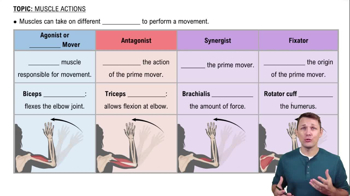
A muscle that assists an agonist by causing a like movement or by stabilizing a joint over which an agonist acts is a(n):
a. Antagonist
b. Prime mover
c. Synergist
d. Agonist
The arm muscle that both flexes and supinates the forearm is the
a. Brachialis
b. Brachioradialis
c. Biceps brachii
d. Triceps brachii
The arrangement of muscle fibers in which the fibers are arranged at an angle to a central longitudinal tendon is:
a. Circular
b. Longitudinal
c. Pennate
d. Parallel
Match the muscle names in column B to the facial muscles described in column A.
Column A
______ (1) squints the eyes
______ (2) raises the eyebrows
______ (3) smiling muscle
______ (4) puckers the lips
______ (5) pulls the scalp posteriorly
Column B
a. corrugator supercilii
b. depressor anguli oris
c. frontal belly of epicranius
d. occipital belly of epicranius
e. orbicularis oculi
f. orbicularis oris
g. zygomaticus