Ch. 11 Fundamentals of the Nervous System and Nervous Tissue
Marieb - Human Anatomy & Physiology 7th Edition
Marieb, Hoehn7th EditionHuman Anatomy & PhysiologyISBN: 9780805359091Not the one you use?Change textbook
Chapter 11, Problem 7

Inhibition of acetylcholinesterase by poisoning blocks neurotransmission at the neuromuscular junction because
a. ACh is no longer released by the presynaptic terminal.
b. ACh synthesis in the presynaptic terminal is blocked.
c. ACh is not degraded, so prolonged depolarization is enforced on the postsynaptic cell.
d. ACh is blocked from attaching to the postsynaptic ACh receptors.

Verified step by step guidance
1
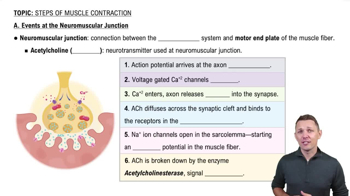
Step 1: Understand the role of acetylcholinesterase (AChE) at the neuromuscular junction. AChE is an enzyme responsible for breaking down acetylcholine (ACh) in the synaptic cleft after it has transmitted the signal to the muscle cell.
Step 2: Recognize what happens when acetylcholinesterase is inhibited. If AChE is blocked, acetylcholine is not degraded and remains in the synaptic cleft for a longer time.
Step 3: Consider the effect of prolonged presence of acetylcholine on the postsynaptic membrane. Continuous presence of ACh causes prolonged activation of ACh receptors, leading to sustained depolarization of the muscle cell membrane.
Step 4: Analyze why this prolonged depolarization blocks neurotransmission. Normally, after a brief depolarization, the muscle cell repolarizes to be ready for the next signal. Prolonged depolarization prevents this reset, effectively blocking further neurotransmission.
Step 5: Match this understanding to the given options. The correct explanation is that acetylcholine is not degraded, so prolonged depolarization is enforced on the postsynaptic cell.

Verified video answer for a similar problem:

This video solution was recommended by our tutors as helpful for the problem above.
Video duration:
3m
Was this helpful?

Key Concepts

Here are the essential concepts you must grasp in order to answer the question correctly.

Role of Acetylcholinesterase at the Neuromuscular Junction

Acetylcholinesterase is an enzyme that breaks down acetylcholine (ACh) in the synaptic cleft, terminating the signal transmission. Its inhibition leads to accumulation of ACh, causing continuous stimulation of the postsynaptic membrane and prolonged muscle contraction.
Recommended video:
Guided course
5:56
A. Events at the Neuromuscular Junction

Mechanism of Neurotransmission at the Neuromuscular Junction

Neurotransmission involves release of ACh from the presynaptic terminal, binding to receptors on the postsynaptic muscle cell, and triggering depolarization that leads to muscle contraction. Proper degradation of ACh is essential to reset the system for subsequent signals.
Recommended video:
Guided course
5:56
A. Events at the Neuromuscular Junction

Effects of Acetylcholinesterase Inhibitors on Muscle Function

Inhibitors of acetylcholinesterase prevent ACh breakdown, causing excessive stimulation of muscle fibers. This results in prolonged depolarization, muscle fatigue, and potentially paralysis, as the postsynaptic receptors remain activated without normal signal termination.
Recommended video:
2:58
Comic Strip for Effects of T Cell Functions