Ch. 12 The Central Nervous System
Marieb - Human Anatomy & Physiology 7th Edition
Marieb, Hoehn7th EditionHuman Anatomy & PhysiologyISBN: 9780805359091Not the one you use?Change textbook
Chapter 12, Problem 4

Choose the correct term from the key to respond to the statements describing various brain areas.
Key:
a. Cerebellum
b. Corpora quadrigemina
c. Corpus callosum
d. Striatum
e. Hypothalamus
f. Medulla
g. Midbrain
h. Pons
i. Thalamus 
________ (1) basal nuclei involved in fine control of motor activities  
________ (2) region where there is a crossover of fibers of descending pyramidal tracts  
________ (3) control of temperature, autonomic nervous system reflexes, hunger, and water balance 
________ (4) houses the substantia nigra and cerebral aqueduct 
________ (5) relay stations for visual and auditory stimuli input; found in midbrain 
________ (6) houses vital centers for control of the heart, respiration, and blood pressure 
________ (7) brain area through which all the sensory input is relayed to get to the cerebral cortex 
________ (8) brain area most concerned with equilibrium, body posture, and coordination of motor activity

Verified step by step guidance
1
Step 1: Identify the brain area associated with basal nuclei involved in fine control of motor activities. Recall that basal nuclei (or basal ganglia) are clusters of neurons that regulate voluntary motor control and procedural learning. From the key, the term 'Striatum' (d) corresponds to this function.
Step 2: Determine the brain region where there is a crossover of fibers of descending pyramidal tracts. This crossover, known as decussation, occurs in the medulla oblongata, which controls vital autonomic functions. From the key, 'Medulla' (f) is the correct choice.
Step 3: Find the brain area responsible for control of temperature, autonomic nervous system reflexes, hunger, and water balance. These functions are regulated by the hypothalamus, so select 'Hypothalamus' (e).
Step 4: Identify the brain area that houses the substantia nigra and cerebral aqueduct. Both structures are located in the midbrain, so choose 'Midbrain' (g).
Step 5: Recognize the relay stations for visual and auditory stimuli input found in the midbrain. These are the corpora quadrigemina, so select 'Corpora quadrigemina' (b).
Step 6: Determine the brain area housing vital centers for control of the heart, respiration, and blood pressure. These centers are located in the medulla, but since medulla is already used, confirm the correct match is 'Medulla' (f).
Step 7: Identify the brain area through which all sensory input is relayed to reach the cerebral cortex. This is the thalamus, so select 'Thalamus' (i).
Step 8: Find the brain area most concerned with equilibrium, body posture, and coordination of motor activity. This is the cerebellum, so choose 'Cerebellum' (a).

Verified video answer for a similar problem:

This video solution was recommended by our tutors as helpful for the problem above.
Video duration:
5m
Was this helpful?

Key Concepts

Here are the essential concepts you must grasp in order to answer the question correctly.

Basal Nuclei and Motor Control

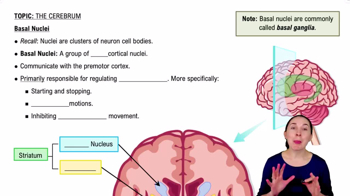
Basal nuclei, also known as basal ganglia, are groups of neurons deep in the brain involved in regulating voluntary motor movements, procedural learning, and coordination. They help fine-tune motor activity by inhibiting unwanted movements and facilitating smooth execution of voluntary actions.
Recommended video:
3:26
Basal Nuclei

Brainstem Structures and Vital Functions

The brainstem, including the medulla, pons, and midbrain, controls essential life functions such as heart rate, respiration, and blood pressure. It also serves as a conduit for motor and sensory pathways and contains centers for reflexes and autonomic regulation.
Recommended video:
06:04
Functional Groups

Sensory Relay and Integration Centers

The thalamus acts as the brain's main relay station, processing and transmitting sensory information to the cerebral cortex. It filters and integrates inputs from various sensory modalities, playing a crucial role in perception, attention, and consciousness.
Recommended video:
2:47
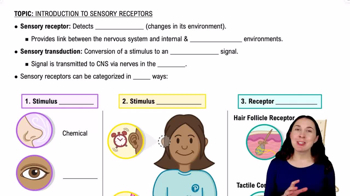
Sensory Receptors