
Textbook Question
Which ANS fibers release acetylcholine? Which release norepinephrine?
1040
views

 Verified step by step guidance
 1:23
1:23
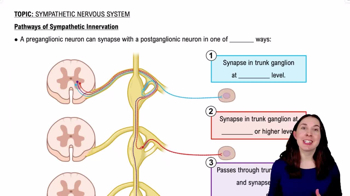 3:09
3:09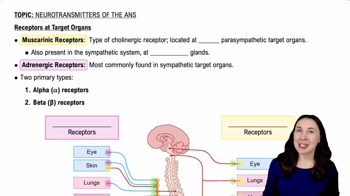 2:50
2:50Which ANS fibers release acetylcholine? Which release norepinephrine?
The white rami communicantes contain what kind of fibers?
a. Preganglionic parasympathetic
b. Postganglionic parasympathetic
c. Preganglionic sympathetic
d. Postganglionic sympathetic
Relate each of the following terms or phrases to either the sympathetic (S) or parasympathetic (P) division of the autonomic nervous system:
______ (7) Generally short-duration action
______ (8) Increases heart rate and blood pressure
______ (9) Increases gastric motility and secretion of lacrimal, salivary, and digestive juices
______ (10) Innervates blood vessels
______ (11) Most active when you are relaxing in a hammock
______ (12) Active when you are running in the Boston Marathon
Where are the cell bodies of visceral sensory neurons?
Briefly explain why the following terms are sometimes used to refer to the autonomic nervous system: involuntary nervous system and emotional-visceral system.
Relate each of the following terms or phrases to either the sympathetic (S) or parasympathetic (P) division of the autonomic nervous system:
______ (1) Short preganglionic, long postganglionic fibers
______ (2) Intramural ganglia
______ (3) Craniosacral part
______ (4) Adrenergic fibers
______ (5) Cervical ganglia
______ (6) Otic and ciliary ganglia