Roger Proulx has severe arthritis and has been taking prednisone (a glucocorticoid) for two months. He isn't feeling well, complains of repeated 'colds,' and is extremely 'puffy' (edematous). Explain the reason for these symptoms.
Ch. 16 The Endocrine System

Marieb, Hoehn7th EditionHuman Anatomy & PhysiologyISBN: 9780805359091Not the one you use?Change textbook
Chapter 15, Problem 17
The posterior pituitary is not really an endocrine gland. Why not? What is it?
Verified step by step guidance1
Understand the definition of an endocrine gland: an endocrine gland synthesizes and secretes hormones directly into the bloodstream.
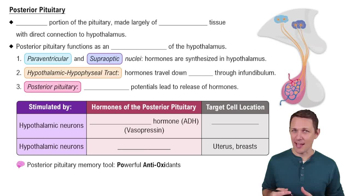
Recognize that the posterior pituitary does not produce its own hormones; instead, it stores and releases hormones made by the hypothalamus.
Identify the hormones involved: the posterior pituitary releases oxytocin and antidiuretic hormone (ADH), which are synthesized in the hypothalamic neurons.
Explain that the posterior pituitary is essentially an extension of the hypothalamus composed of neural tissue, functioning as a neurosecretory organ.
Conclude that because it does not synthesize hormones but only stores and releases them, the posterior pituitary is not a true endocrine gland but a neurohypophysis.

Verified video answer for a similar problem:
This video solution was recommended by our tutors as helpful for the problem above.
Video duration:
1mWas this helpful?
Key Concepts
Here are the essential concepts you must grasp in order to answer the question correctly.
Structure and Function of the Posterior Pituitary
The posterior pituitary is composed mainly of neural tissue and does not synthesize hormones itself. Instead, it stores and releases hormones produced by the hypothalamus, such as oxytocin and vasopressin, directly into the bloodstream.
Recommended video:
Guided course
Posterior Pituitary
Neuroendocrine Relationship
The posterior pituitary acts as a neuroendocrine interface, where nerve cells from the hypothalamus extend their axons into the pituitary to release hormones. This connection highlights its role as a neural extension rather than a traditional endocrine gland.
Recommended video:
Guided course
Formalizing Pressure Relationships in the Lungs
Difference Between Anterior and Posterior Pituitary
Unlike the anterior pituitary, which is a true endocrine gland synthesizing hormones, the posterior pituitary does not produce hormones but releases those made by hypothalamic neurons. This distinction explains why it is not classified as a typical endocrine gland.
Recommended video:
Guided course
Posterior Pituitary
Related Practice
Textbook Question
858
views
Textbook Question
Endemic goiter is not really the result of a malfunctioning thyroid gland. What does cause it?
922
views
Textbook Question
Describe the body location of each of the following endocrine organs: anterior pituitary, pineal gland, pancreas, ovaries, testes, and adrenal glands.
List the hormones produced by each organ.
859
views
Textbook Question
Which type of hormone receptor—plasma membrane bound or intracellular—would be expected to provide the most long-lived response to hormone binding and why?
1568
views
Textbook Question
The anterior pituitary is often referred to as the master endocrine organ, but it, too, has a 'master.' What controls the release of anterior pituitary hormones?
739
views
Textbook Question
Name a hormone secreted by a muscle cell and two hormones secreted by neurons.
853
views
