Ch. 27 The Reproductive System
Marieb - Human Anatomy & Physiology 7th Edition
Marieb, Hoehn7th EditionHuman Anatomy & PhysiologyISBN: 9780805359091Not the one you use?Change textbook
Chapter 26, Problem 7

Which of the following produces the male sex hormones?
a. Seminal glands
b. Corpus luteum
c. Developing follicles in the testes
d. Interstitial endocrine cells

Verified step by step guidance
1
Step 1: Understand the role of male sex hormones, primarily testosterone, which is responsible for the development of male secondary sexual characteristics and is produced in the testes.
Step 2: Review the anatomy of the testes. The testes contain seminiferous tubules where sperm is produced and interstitial endocrine cells (also known as Leydig cells) located in the spaces between the tubules.
Step 3: Learn the function of interstitial endocrine cells. These cells are responsible for producing and secreting testosterone, the primary male sex hormone.
Step 4: Eliminate incorrect options. Seminal glands are involved in producing seminal fluid, not hormones. The corpus luteum and developing follicles are structures found in the ovaries, not the testes, and are associated with female reproductive hormones.
Step 5: Conclude that the correct answer is interstitial endocrine cells, as they are the specific cells in the testes responsible for producing male sex hormones.

Verified video answer for a similar problem:

This video solution was recommended by our tutors as helpful for the problem above.
Video duration:
2m
Was this helpful?

Key Concepts

Here are the essential concepts you must grasp in order to answer the question correctly.

Male Sex Hormones

Male sex hormones, primarily testosterone, are crucial for the development of male reproductive tissues, secondary sexual characteristics, and overall male health. They play a significant role in processes such as spermatogenesis and libido. Understanding their production and regulation is essential for comprehending male reproductive physiology.
Recommended video:
Guided course
13:06
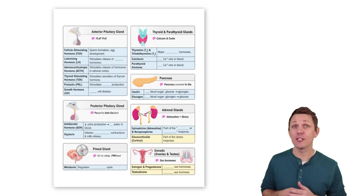
Review of Major Hormones

Interstitial Endocrine Cells

Interstitial endocrine cells, also known as Leydig cells, are located in the testes and are responsible for the production of testosterone. These cells are stimulated by luteinizing hormone (LH) from the pituitary gland, which triggers the synthesis of male hormones. Their function is vital for male sexual development and reproductive function.
Recommended video:
Guided course
7:06
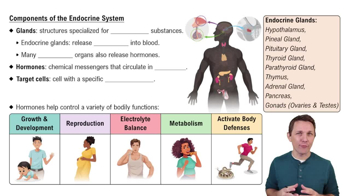
Components of the Endocrine System

Testes Anatomy

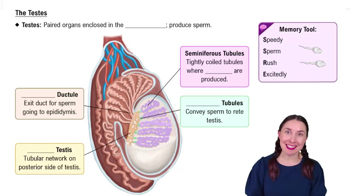
The testes are the male reproductive organs that produce sperm and hormones. They contain various structures, including seminiferous tubules where sperm is produced and interstitial spaces housing Leydig cells. Understanding the anatomy and function of the testes is essential for grasping how male sex hormones are produced and regulated.
Recommended video:
2:47
The Testes
Related Practice
Textbook Question

Which of the following does not add a secretion that makes a major contribution to semen?

a. Prostate

b. Bulbo-urethral glands

c. Testes

d. Ductus deferens

136
views
Textbook Question

Match the key choices with the descriptive phrases below.

Key:

a. Androgen-binding protein

b. Estrogens

c. FSH

d. GnRH

e. Inhibin

f. LH

g. Progesterone

h. Testosterone

(1) Hormones that directly regulate the ovarian cycle

(2) Chemicals in males that inhibit the hypothalamic-pituitary-testicular axis

(3) Hormone that makes the cervical mucus viscous

(4) Potentiates the activity of testosterone on spermatogenic cells

(5) Chemicals in females that inhibit the hypothalamic-pituitary-ovarian axis

(6) Stimulates the secretion of testosterone

152
views
Textbook Question

The usual site of embryo implantation is:

a. The uterine tube

b. The peritoneal cavity

c. The vagina

d. The uterus

49
views
Textbook Question

Secondary sex characteristics are:

a. Present in the embryo

b. A result of male or female sex hormones increasing in amount at puberty

c. The testis in the male and the ovary in the female

d. Development of male and female external genitalia

112
views
Textbook Question

Which will occur as a result of non-descent of the testes from the interior of the pelvis to the superficial scrotum?

a. Male sex hormones will not be circulated in the body.

b. Sperm will have no means of exit from the body.

c. Inadequate blood supply will retard the development of the testes.

d. Viable sperm will not be produced.

209
views
Textbook Question

Which of the following is correct relative to female anatomy?

a. The vaginal orifice is the most dorsal of the three openings in the perineum.

b. The urethra is between the vaginal orifice and the anus.

c. The anus is between the vaginal orifice and the urethra.

d. The urethra is the more ventral of the two orifices in the vulva.

1196
views