In adults, over 90% of all cancers arise in epithelium. Such cancers are called carcinomas, or adenomas (adenocarcinomas) if they arise in glandular epithelia. In fact, cancers of the skin, lung, colon, breast, and prostate are all in these categories. Why do you think this is so?
Ch. 4 Tissue: The Living Fabric

Marieb, Hoehn7th EditionHuman Anatomy & PhysiologyISBN: 9780805359091Not the one you use?Change textbook
Chapter 4, Problem 17
Mrs. Delancy went to the local meat market and bought a beef tenderloin (cut from the loin, the region along the steer's caudal vertebral column) and some tripe (cow's stomach). What type of muscle was she preparing to eat in each case?
Verified step by step guidance1
Identify the type of muscle tissue found in the beef tenderloin. Since the tenderloin is a cut from the loin region along the steer's caudal vertebral column, it is skeletal muscle, which is attached to bones and responsible for voluntary movement.
Recognize the type of muscle tissue present in tripe, which is the lining of a cow's stomach. The stomach wall is composed primarily of smooth muscle, which is involuntary and found in the walls of hollow organs.
Understand the characteristics of skeletal muscle: it is striated, multinucleated, and under voluntary control, making it suitable for movement and posture.
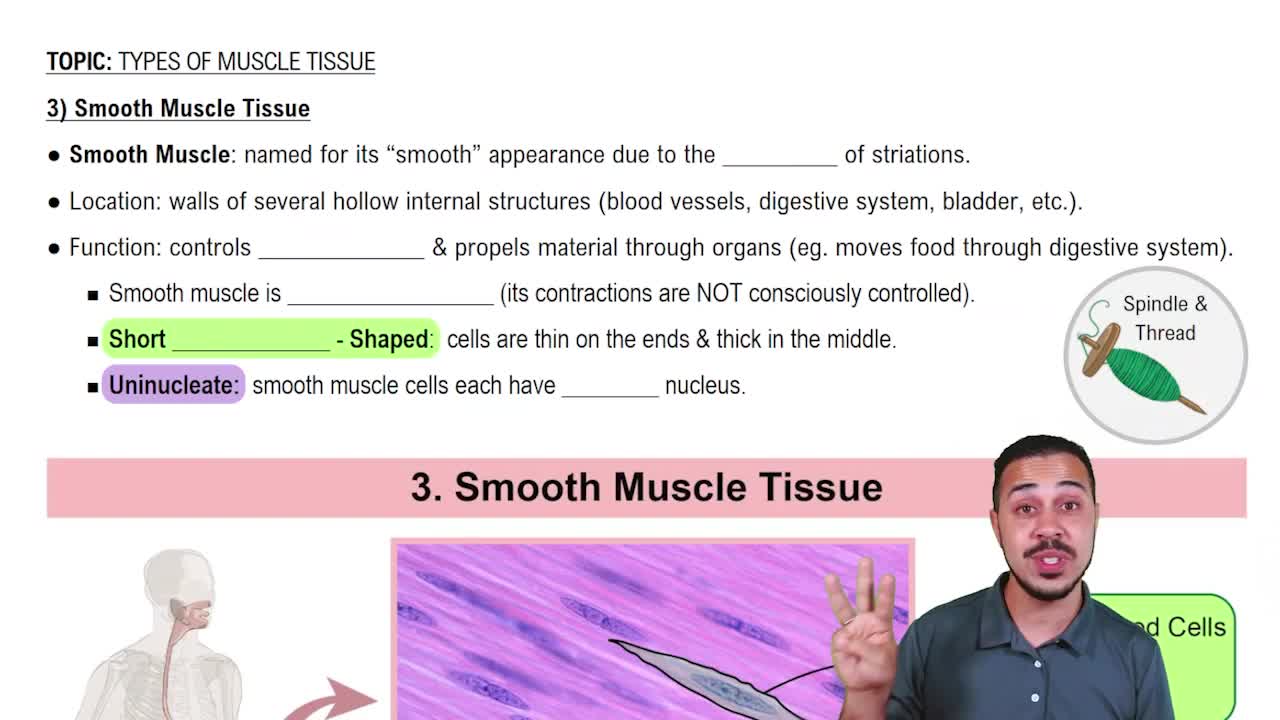
Understand the characteristics of smooth muscle: it is non-striated, has a single nucleus per cell, and is controlled involuntarily to facilitate functions like digestion.
Summarize that Mrs. Delancy was preparing to eat skeletal muscle when consuming the beef tenderloin and smooth muscle when consuming the tripe.

Verified video answer for a similar problem:
This video solution was recommended by our tutors as helpful for the problem above.
Video duration:
3mWas this helpful?
Key Concepts
Here are the essential concepts you must grasp in order to answer the question correctly.
Skeletal Muscle
Skeletal muscle is a type of striated muscle attached to bones, responsible for voluntary movements. It is characterized by long, multinucleated fibers and is the primary muscle type found in meat cuts like beef tenderloin, which comes from the loin region of the steer.
Recommended video:
Guided course
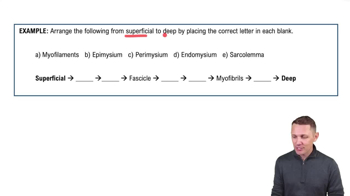
Structure of a Skeletal Muscle Example 2
Smooth Muscle
Smooth muscle is an involuntary, non-striated muscle found in the walls of internal organs such as the stomach, intestines, and blood vessels. Tripe, which is cow's stomach lining, consists mainly of smooth muscle tissue, differing in texture and function from skeletal muscle.
Recommended video:
Guided course
Smooth Muscle Tissue
Muscle Anatomy and Meat Cuts
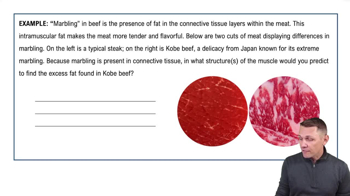
Understanding muscle anatomy helps identify the source and type of muscle in meat products. The beef tenderloin is a skeletal muscle from the loin near the vertebral column, while tripe is derived from smooth muscle in the stomach, highlighting differences in muscle structure and culinary uses.
Recommended video:
Guided course
Structure of a Skeletal Muscle Example 1
Related Practice
Textbook Question
1257
views
Textbook Question
John sustained a severe injury during football practice and is told that he has a torn knee cartilage. Can he expect a quick, uneventful recovery? Explain your response.
892
views
Textbook Question
Matrix is extracellular. How does the matrix get to its characteristic position?
1448
views
Textbook Question
Differentiate between the roles of neurons and the supporting cells of nervous tissue.
1147
views
1
rank
Textbook Question
In what ways are adipose tissue and bone similar? How are they different?
1075
views
Textbook Question
Compare and contrast skeletal, cardiac, and smooth muscle tissue relative to structure, body location, and specific function.
1807
views
1
rank
