Ch. 11 The Muscular System
Martini - Fundamentals of Anatomy & Physiology 11th Edition
Martini, Nath, Bartholomew11th EditionFundamentals of Anatomy & PhysiologyISBN: 9780136874089Not the one you use?Change textbook
Chapter 11, Problem 1

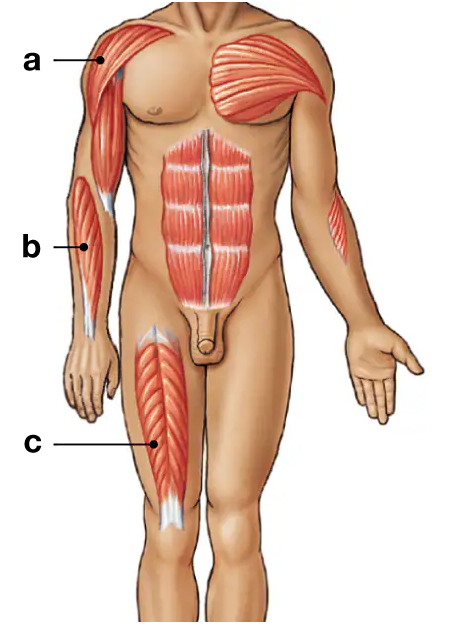
Name the three pennate muscles in the following figure, and for each muscle indicate the type of pennate muscle based on the relationship of muscle fascicles to the tendon.
Front view of a male body highlighting three labeled muscles on the shoulder, forearm, and thigh.
a. ___
b. ___
c. ___
d. ___
e. ___
f. ___

Verified step by step guidance
1
Step 1: Understand the types of pennate muscles. There are three main types: unipennate, bipennate, and multipennate. Unipennate muscles have fascicles that insert into one side of the tendon, bipennate muscles have fascicles inserting into both sides of a central tendon, and multipennate muscles have fascicles attaching at multiple angles to several tendons.
Step 2: Identify the three pennate muscles in the figure by their anatomical names. Common examples include the extensor digitorum longus (unipennate), rectus femoris (bipennate), and deltoid (multipennate). Use the figure to match the muscle shapes and locations to these or other known pennate muscles.
Step 3: For each identified muscle, observe the arrangement of muscle fascicles relative to the tendon. Determine if the fascicles approach the tendon from one side (unipennate), both sides (bipennate), or multiple directions (multipennate).
Step 4: Assign the correct type of pennate muscle to each identified muscle based on your observations. For example, if the fascicles insert on one side of the tendon, label it as unipennate.
Step 5: Write down the names of the three pennate muscles along with their corresponding pennate type, ensuring clarity and accuracy in your answers.

Verified video answer for a similar problem:

This video solution was recommended by our tutors as helpful for the problem above.
Video duration:
4m
Was this helpful?

Key Concepts

Here are the essential concepts you must grasp in order to answer the question correctly.

Pennate Muscle Structure

Pennate muscles have fascicles that attach obliquely to a central tendon, allowing for greater force production compared to parallel muscles. The arrangement can be unipennate, bipennate, or multipennate, depending on how the fascicles align relative to the tendon.
Recommended video:
Guided course
3:04
Structure of a Skeletal Muscle Example 1

Types of Pennate Muscles

Unipennate muscles have fascicles on one side of the tendon, bipennate muscles have fascicles on both sides, and multipennate muscles have multiple tendons with fascicles arranged around them. Identifying these types helps classify muscles based on their architecture.
Recommended video:
Guided course
00:36
3 Types of Muscle Tissue

Identification of Specific Muscles

Recognizing the names and locations of pennate muscles in anatomical figures is essential. Common examples include the extensor digitorum (unipennate), rectus femoris (bipennate), and deltoid (multipennate), which aids in linking structure to function.
Recommended video:
Guided course
16:19
Epithelium Identification Flow Chart