Ch. 17 The Special Senses
Martini - Fundamentals of Anatomy & Physiology 11th Edition
Martini, Nath, Bartholomew11th EditionFundamentals of Anatomy & PhysiologyISBN: 9780136874089Not the one you use?Change textbook
Chapter 17, Problem 21

Displacement of stereocilia toward the kinocilium of a hair cell
(a) Produces a depolarization of the membrane
(b) Produces a hyperpolarization of the membrane
(c) Decreases the membrane permeability to sodium ions
(d) Increases the membrane permeability to potassium ions
(e) Does not affect the membrane potential of the cell

Verified step by step guidance
1
Understand the structure of hair cells in the inner ear, specifically the role of stereocilia and the kinocilium in mechanotransduction.
Recognize that displacement of stereocilia toward the kinocilium causes mechanically gated ion channels to open.
Identify which ions flow through these channels; in hair cells, potassium ions (K+) from the endolymph enter the cell due to the high K+ concentration outside.
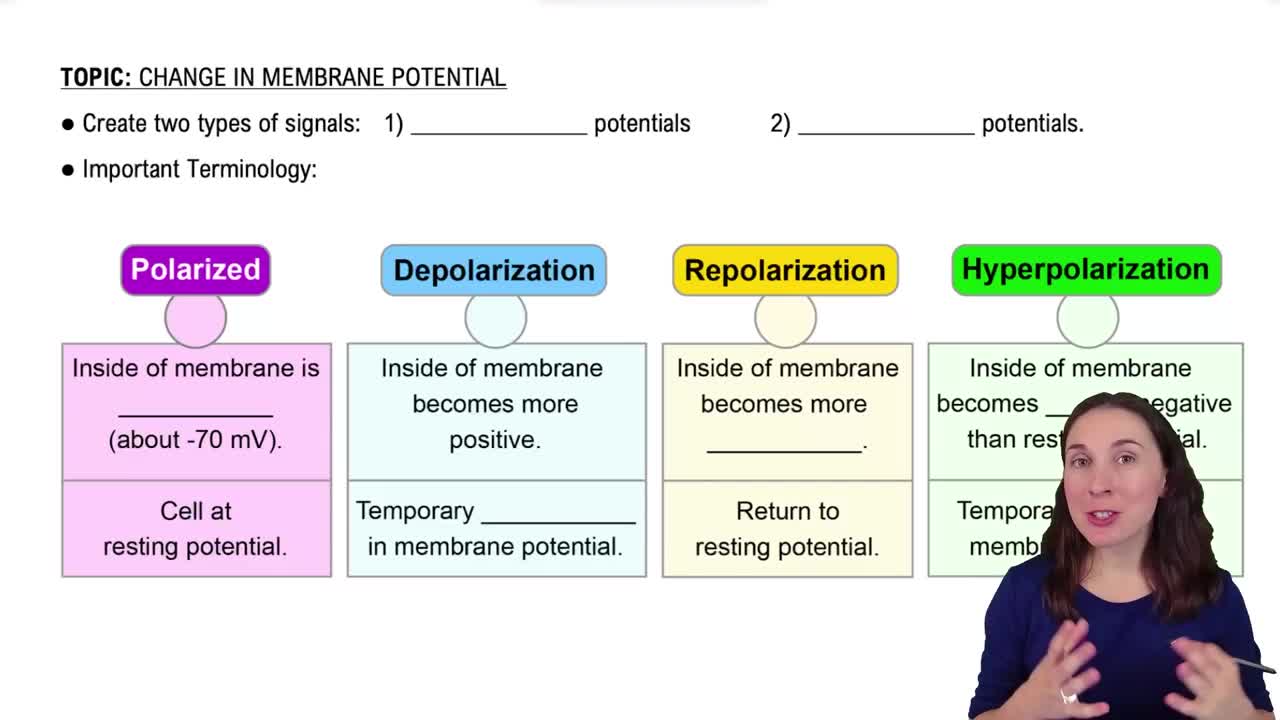
Understand that the influx of K+ ions depolarizes the hair cell membrane, making the inside more positive.
Conclude that displacement of stereocilia toward the kinocilium increases membrane permeability to potassium ions and produces depolarization of the membrane.

Verified video answer for a similar problem:

This video solution was recommended by our tutors as helpful for the problem above.
Was this helpful?

Key Concepts

Here are the essential concepts you must grasp in order to answer the question correctly.

Structure and Function of Hair Cells

Hair cells are sensory receptors in the inner ear that detect mechanical stimuli through their stereocilia. The kinocilium is a specialized, taller cilium that helps determine the direction of stereocilia displacement, which influences the cell's electrical response.
Recommended video:
05:33
Cell Junctions

Mechanotransduction in Hair Cells

Displacement of stereocilia toward the kinocilium opens mechanically gated ion channels, allowing ions to flow into the hair cell. This process converts mechanical movement into an electrical signal, typically leading to depolarization when channels open.
Recommended video:
07:02
Other Epidermal Cells

Ion Permeability and Membrane Potential Changes

In hair cells, potassium ions (K+) from the endolymph enter through open channels during stereocilia deflection toward the kinocilium, increasing membrane permeability to K+ and causing depolarization. This depolarization triggers neurotransmitter release and signal transmission.
Recommended video:
03:31
Change in Membrane Potential