Ch. 18 The Endocrine System
Martini - Fundamentals of Anatomy & Physiology 11th Edition
Martini, Nath, Bartholomew11th EditionFundamentals of Anatomy & PhysiologyISBN: 9780136874089Not the one you use?Change textbook
Chapter 18, Problem 1

The use of a chemical messenger to transfer information from cell to cell within a single tissue is referred to as _____ communication.
(a) Direct
(b) Paracrine
(c) Hormonal
(d) Endocrine

Verified step by step guidance
1
Step 1: Understand the types of cell communication. Cell communication can occur in several ways, including direct contact, paracrine signaling, hormonal signaling, and endocrine signaling.
Step 2: Define direct communication. Direct communication involves the transfer of signals through gap junctions between adjacent cells, allowing ions and small molecules to pass directly.
Step 3: Define paracrine communication. Paracrine signaling involves the release of chemical messengers that affect nearby cells within the same tissue, without entering the bloodstream.
Step 4: Define hormonal and endocrine communication. Hormonal or endocrine communication involves chemical messengers (hormones) released into the bloodstream to affect distant target cells throughout the body.
Step 5: Match the description. Since the problem states the transfer of information from cell to cell within a single tissue using a chemical messenger, this corresponds to paracrine communication.

Verified video answer for a similar problem:

This video solution was recommended by our tutors as helpful for the problem above.
Was this helpful?

Key Concepts

Here are the essential concepts you must grasp in order to answer the question correctly.

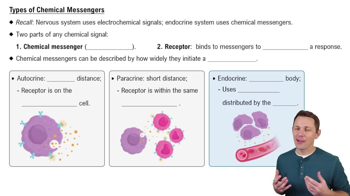
Chemical Messenger

Chemical messengers are molecules released by cells to transmit signals to other cells. They enable communication within and between tissues, coordinating physiological responses. Examples include neurotransmitters, hormones, and local mediators.
Recommended video:
Guided course
4:01
Types of Chemical Messengers

Paracrine Communication

Paracrine communication involves the release of chemical messengers that act on nearby cells within the same tissue. Unlike endocrine signaling, these messengers do not enter the bloodstream but affect only local target cells.
Recommended video:
2:59
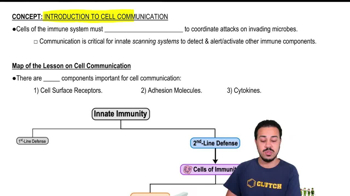
Map of the Lesson on Cell Communication

Types of Cell Communication

Cell communication can be direct (through gap junctions), paracrine (local signaling), endocrine (hormones traveling through blood), or autocrine (acting on the same cell). Understanding these types helps identify how signals are transmitted in different contexts.
Recommended video:
2:59
Map of the Lesson on Cell Communication