Ch. 19 Blood
Martini - Fundamentals of Anatomy & Physiology 11th Edition
Martini, Nath, Bartholomew11th EditionFundamentals of Anatomy & PhysiologyISBN: 9780136874089Not the one you use?Change textbook
Chapter 19, Problem 29

In the disease mononucleosis ('mono'), the spleen enlarges because of increased numbers of phagocytes and other cells. Common signs and symptoms of this disease include pale complexion, a tired feeling, and a lack of energy sometimes to the point of not being able to get out of bed. What might cause these signs and symptoms?

Verified step by step guidance
1
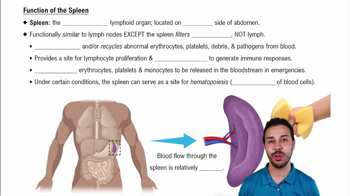
Step 1: Understand the role of the spleen in the body. The spleen filters blood, removes old or damaged red blood cells, and helps fight infection by producing and storing white blood cells (phagocytes and lymphocytes).
Step 2: Recognize that in mononucleosis, the spleen enlarges due to an increased number of immune cells responding to the infection, which can affect its normal function.
Step 3: Consider how an enlarged spleen might impact red blood cells. The spleen may start to trap and destroy more red blood cells than usual, leading to a reduced number of circulating red blood cells, a condition known as anemia.
Step 4: Connect anemia to the symptoms described: a pale complexion results from fewer red blood cells carrying oxygen, and the tiredness and lack of energy occur because tissues receive less oxygen, impairing cellular function and energy production.
Step 5: Summarize that the signs and symptoms in mononucleosis are caused by the spleen's enlargement leading to increased destruction of red blood cells, resulting in anemia and reduced oxygen delivery to the body.

Verified video answer for a similar problem:

This video solution was recommended by our tutors as helpful for the problem above.
Was this helpful?

Key Concepts

Here are the essential concepts you must grasp in order to answer the question correctly.

Role of the Spleen in Immune Response

The spleen filters blood and helps fight infections by producing and housing immune cells like phagocytes. In mononucleosis, the spleen enlarges due to increased immune activity, which can affect its normal function and contribute to symptoms.
Recommended video:
7:11
Function of the Spleen

Impact of Enlarged Spleen on Blood Cells

An enlarged spleen can trap and destroy more blood cells than usual, including red blood cells and platelets. This can lead to anemia, causing pale complexion and fatigue due to reduced oxygen delivery to tissues.
Recommended video:
7:11
Function of the Spleen

Symptoms of Anemia and Fatigue

Anemia results in decreased oxygen transport, leading to tiredness, weakness, and lack of energy. These symptoms occur because the body’s tissues receive less oxygen, impairing normal cellular function and causing the patient to feel exhausted.
Recommended video:
3:32
Introduction to the Lymphatic System Example 2