Ch. 20 The Heart
Martini - Fundamentals of Anatomy & Physiology 11th Edition
Martini, Nath, Bartholomew11th EditionFundamentals of Anatomy & PhysiologyISBN: 9780136874089Not the one you use?Change textbook
Chapter 20, Problem 10

During diastole, a chamber of the heart:
(a) Relaxes and fills with blood
(b) Contracts and pushes blood into an adjacent chamber
(c) Experiences a sharp increase in pressure
(d) Reaches a pressure of approximately 120 mm Hg

Verified step by step guidance
1
Understand the cardiac cycle phases: systole and diastole. Systole refers to the contraction phase of the heart chambers, while diastole refers to the relaxation phase.
Recall that during diastole, the heart chambers relax after contraction, allowing them to fill with blood coming from either the veins or the adjacent heart chambers.
Recognize that during diastole, the pressure inside the heart chambers decreases to facilitate blood flow into the chambers, so a sharp increase in pressure is not characteristic of diastole.
Note that a pressure of approximately 120 mm Hg is typical of systolic pressure in the left ventricle during contraction, not during diastole.
Conclude that the correct description of what happens during diastole is that the heart chamber relaxes and fills with blood.

Verified video answer for a similar problem:

This video solution was recommended by our tutors as helpful for the problem above.
Was this helpful?

Key Concepts

Here are the essential concepts you must grasp in order to answer the question correctly.

Cardiac Cycle Phases

The cardiac cycle consists of systole and diastole phases. Diastole is the relaxation phase when heart chambers fill with blood, while systole is the contraction phase that pumps blood out. Understanding these phases is essential to interpret heart function and pressure changes.
Recommended video:
Guided course
3:55
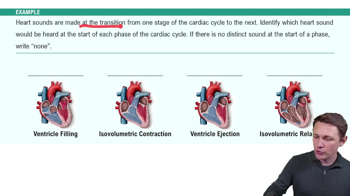
Cardiac Cycle Example 3

Heart Chamber Function During Diastole

During diastole, the heart chambers, especially the atria and ventricles, relax to allow blood to flow in from veins or adjacent chambers. This filling phase is crucial for maintaining adequate cardiac output and ensuring efficient circulation.
Recommended video:
06:04
Functional Groups

Blood Pressure in the Heart

Blood pressure within heart chambers varies during the cardiac cycle. During diastole, pressure is relatively low to facilitate filling, whereas systole generates higher pressures (e.g., around 120 mm Hg in the left ventricle) to propel blood into arteries.
Recommended video:
Guided course
6:12
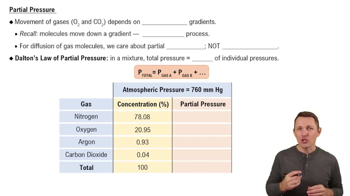
Partial Pressure