Ch. 20 The Heart
Martini - Fundamentals of Anatomy & Physiology 11th Edition
Martini, Nath, Bartholomew11th EditionFundamentals of Anatomy & PhysiologyISBN: 9780136874089Not the one you use?Change textbook
Chapter 20, Problem 3

The serous membrane covering the outer surface of the heart is the:
(a) Parietal layer of the serous pericardium
(b) Endocardium
(c) Myocardium
(d) Visceral layer of the serous pericardium

Verified step by step guidance
1
Step 1: Understand the structure of the serous pericardium, which is a double-layered membrane surrounding the heart. It consists of two layers: the parietal layer (outer) and the visceral layer (inner).
Step 2: Recognize that the visceral layer of the serous pericardium is also known as the epicardium, which directly covers the outer surface of the heart.
Step 3: Differentiate the other options: the endocardium lines the inner chambers of the heart, and the myocardium is the thick muscular middle layer responsible for contraction.
Step 4: Identify that the parietal layer of the serous pericardium lines the inner surface of the fibrous pericardium, not the heart itself.
Step 5: Conclude that the serous membrane covering the outer surface of the heart is the visceral layer of the serous pericardium.

Verified video answer for a similar problem:

This video solution was recommended by our tutors as helpful for the problem above.
Was this helpful?

Key Concepts

Here are the essential concepts you must grasp in order to answer the question correctly.

Serous Pericardium

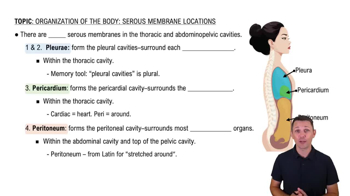
The serous pericardium is a double-layered membrane surrounding the heart. It consists of the parietal layer lining the fibrous pericardium and the visceral layer, also called the epicardium, which directly covers the heart's outer surface.
Recommended video:
Guided course
3:55
Locations of Serous Membranes

Layers of the Heart Wall

The heart wall has three layers: the endocardium (inner lining), myocardium (muscular middle layer responsible for contraction), and epicardium (outer layer, which is the visceral layer of the serous pericardium). Each layer has distinct structure and function.
Recommended video:
02:31
Epidermal Layers: Stratum Lucidum (Clear Layer)

Visceral vs Parietal Layers

The visceral layer of the serous pericardium adheres tightly to the heart surface, while the parietal layer lines the inner surface of the fibrous pericardium. The space between them contains fluid to reduce friction during heartbeats.
Recommended video:
2:12
Visceral Reflex Arcs