
Ch. 20 The Heart
Martini - Fundamentals of Anatomy & Physiology 11th Edition
Martini, Nath, Bartholomew11th EditionFundamentals of Anatomy & PhysiologyISBN: 9780136874089Not the one you use?Change textbook
Chapter 20, Problem 23

What are the sources and significance of the four heart sounds?

Verified step by step guidance
1
Step 1: Identify the four heart sounds, commonly labeled as S1, S2, S3, and S4, and understand that they are produced by specific mechanical events during the cardiac cycle.
Step 2: Explain the source of the first heart sound (S1), which is primarily caused by the closure of the atrioventricular (mitral and tricuspid) valves at the beginning of ventricular systole.
Step 3: Describe the second heart sound (S2), which results from the closure of the semilunar valves (aortic and pulmonary valves) at the end of ventricular systole, marking the beginning of ventricular diastole.
Step 4: Discuss the third heart sound (S3), which is associated with rapid ventricular filling during early diastole and can be normal in children or indicate pathology in adults, such as heart failure.
Step 5: Clarify the origin of the fourth heart sound (S4), which occurs during atrial contraction and is caused by blood being forced into a stiff or hypertrophic ventricle, often indicating decreased ventricular compliance.

Verified video answer for a similar problem:

This video solution was recommended by our tutors as helpful for the problem above.
Was this helpful?

Key Concepts

Here are the essential concepts you must grasp in order to answer the question correctly.

Sources of the Four Heart Sounds

The four heart sounds originate from specific mechanical events during the cardiac cycle. The first (S1) and second (S2) sounds are caused by the closure of the atrioventricular and semilunar valves, respectively. The third (S3) and fourth (S4) sounds arise from vibrations in the ventricular walls during rapid filling and atrial contraction.
Recommended video:
Guided course
6:13
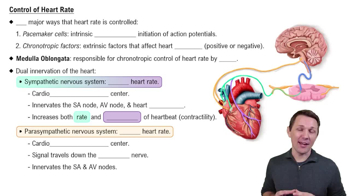
Control of Heart Rate

Physiological Significance of Heart Sounds

Heart sounds provide important information about cardiac function and valve integrity. S1 and S2 indicate normal valve closures, while abnormal variations or extra sounds (S3, S4) can signal conditions like heart failure or stiff ventricles. They help clinicians assess heart health non-invasively.
Recommended video:
Guided course
6:13
Control of Heart Rate

Clinical Interpretation of Heart Sounds

Understanding the timing, intensity, and quality of heart sounds aids in diagnosing cardiac abnormalities. For example, a loud S1 may indicate mitral stenosis, while an S3 can suggest volume overload. Recognizing these sounds is essential for effective cardiac assessment and treatment planning.
Recommended video:
Guided course
6:13
Control of Heart Rate